
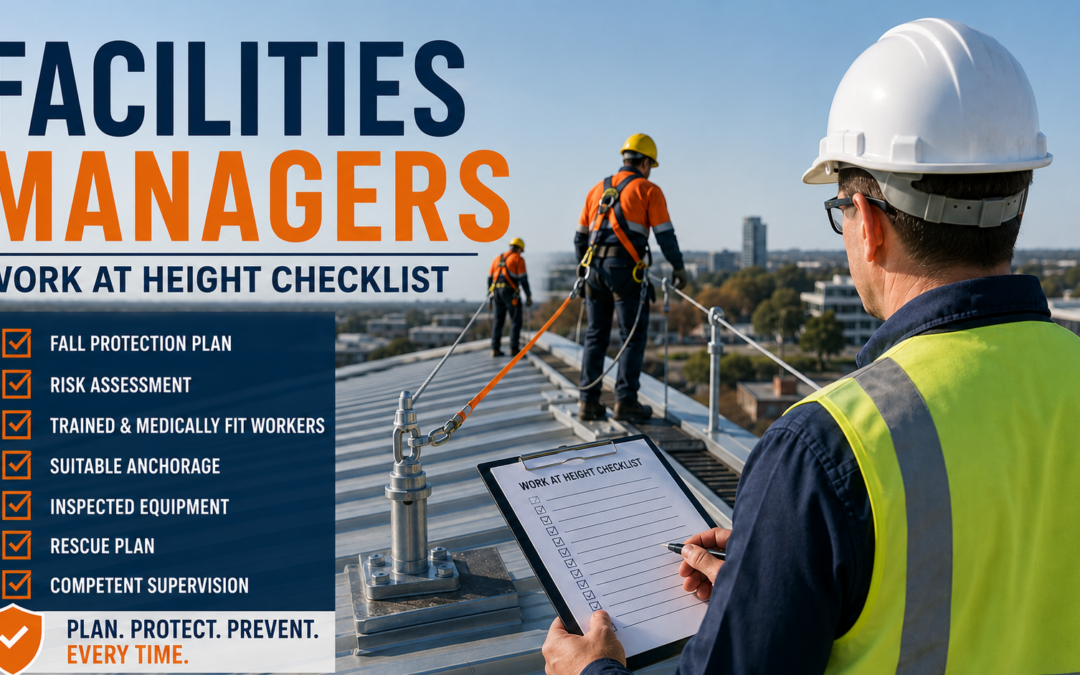
If contractors are going to work at height on your site, checking that they have harnesses and training certificates is not enough.
As the facilities, maintenance, safety or project manager, you need confidence that the work has been properly planned, the fall risks have been assessed, the workers are competent and medically fit, the fall-protection equipment is suitable and there is a workable rescue plan.
You do not need to become a work-at-height specialist yourself. But you do need to know what should be in place before allowing the work to start.
1. Is there a fall protection plan?
This should be one of the first documents you ask for.
A fall protection plan must deal with the actual work being performed from a fall-risk position.
It should include:
- A risk assessment of the work
- The procedures and methods used to control the fall risks
- Medical fitness requirements
- Training requirements
- Inspection, testing and maintenance of fall-protection equipment
- A rescue plan
A generic document that could apply to any building or site should raise questions.
The plan should reflect the actual building, access route, work area, equipment and fall hazards involved.
2. Has the actual fall risk been assessed?
The contractor should have identified where and how a person could fall.
This may include:
- Roof edges
- Fragile roof sheeting
- Skylights
- Openings
- Ladders
- Changes in roof level
- Plant platforms
- Unprotected access routes
- Movement between work positions
The important question is not simply whether a risk assessment exists.
Does the risk assessment describe the hazards that actually exist on your site?
3. Is fall prevention being considered before fall arrest?
Fall prevention should be considered before relying on a system that only arrests a worker after a fall has already occurred.
This may involve:
- Guardrails
- Barriers
- Work restraint
- Suitable access equipment
- Changing the work method
Fall-arrest equipment should be used where preventing exposure to the fall risk is not reasonably practicable.
Read more about the difference between fall arrest and fall prevention.
4. Where are the workers going to attach themselves?
This is one of the most useful questions a facilities manager can ask.
If the answer is:
“We will find something to clip onto when we get up there”
the work should not start.
The fall-protection system should already identify the correct anchorage arrangement.
This could involve:
- Purpose-designed anchor points
- Horizontal anchor lines
- Vertical anchor lines
- Another specifically designed fall-protection system
Do not assume that an existing eyebolt, handrail, steel member, pipe or bracket is suitable simply because workers have used it before.
The anchorage and supporting structure must be suitable for the intended fall-protection system and the loads that could be imposed on it.
Read Fall Protection Anchor Points in South Africa: What You Must Know.
5. Are the workers trained for the actual work they are doing?
A working-at-height certificate does not automatically make someone competent to perform every type of height-related work.
The training should suit the task and equipment being used.
Specialised competence may be required for work involving:
- Temporary Suspended Platforms
- Aluminium access towers
- Fall-arrest systems
- Anchor systems
- Specialised suspended access equipment
- Rescue procedures
Do not only ask:
“Do they have certificates?”
Ask:
“Are they trained and competent for the equipment and work they are about to perform?”
See Is Working at Heights Training Compulsory in South Africa?
6. Are the workers medically fit?
Workers exposed to a fall risk must be medically suitable for the work they are expected to perform.
The fall protection plan must address the process used to evaluate medical fitness.
This is separate from training.
A person may hold a valid training certificate but still not be medically fit to work from a fall-risk position.
7. Has the fall-protection equipment been inspected?
The fall protection plan must address the inspection, testing and maintenance of fall-protection equipment.
Depending on the work, this may include:
- Harnesses
- Lanyards
- Connectors
- Anchor points
- Anchor lines
- Temporary Suspended Platforms
- Access equipment
- Other fall-protection devices
Ask for evidence that the equipment is suitable and in serviceable condition.
Equipment that is damaged, modified, unidentified or of uncertain history should not simply be accepted because somebody says it has always been used that way.
8. What is the rescue plan?
This is one of the most important parts of the entire fall-protection system.
If someone falls into their harness, how will they be rescued?
The fall protection plan must include a rescue plan detailing:
- The rescue procedure
- The people who will carry out the rescue
- The equipment required
- How the rescue can be carried out immediately after a fall
A rescue plan should be practical for the actual work location.
Simply writing “call emergency services” does not explain how a suspended worker will be reached and recovered from the specific position where the work is taking place.
9. Who is responsible for controlling the work?
Before the contractor starts, establish who is responsible for the work-at-height operation.
You should know:
- Who prepared the fall protection plan
- Who supervises the workers
- Who checks that the fall-protection system is being used correctly
- Who has the authority to stop the work
- Who deals with changes or unexpected hazards
A safety file does not control the work by itself.
Someone must ensure that what is actually happening on site follows the plan.
10. Does the work on site match the paperwork?
This is where many work-at-height systems fail.
The paperwork may show approved anchor points while workers are actually clipping onto handrails.
The fall protection plan may show one access route while workers use another.
The documentation may refer to an anchor line that is not installed.
The rescue plan may require equipment that is not actually on site.
The documented system and the actual work must match.
A simple facilities manager checklist
Before contractors start working at height, confirm:
- There is a site-specific fall protection plan
- The fall hazards have been assessed
- The work method addresses those hazards
- Fall prevention has been considered before fall arrest
- The correct anchorage system has been identified
- The anchor points or anchor lines are suitable
- The workers are trained for the actual work
- The workers are medically fit
- The fall-protection equipment has been inspected
- A practical rescue plan is in place
- The required rescue equipment is available
- Someone competent is controlling the work
- The actual site conditions match the approved plan
What if the contractor says, “We do this all the time”?
Experience is valuable, but it does not replace proper planning.
Every building, roof, façade and work position can introduce different hazards.
A contractor who regularly performs work at height should be able to clearly explain:
- How the work will be carried out
- How workers will be protected
- Where they will attach
- What equipment they will use
- What happens if someone falls
If those questions cannot be answered before the job starts, management should be cautious about allowing the work to proceed.
You do not have to become the work-at-height expert
The challenge for many facilities, safety and maintenance managers is not knowing whether the documents and equipment presented to them are actually suitable.
You may have:
- A large safety file
- Training certificates
- Harnesses
- Anchor points
- Risk assessments
and still not know whether the complete system is safe.
The goal should be certainty before workers are exposed to the fall risk.
Work at Height Solutions can assess your work-at-height arrangements, identify gaps in the fall-protection system and advise on the training, equipment, anchor systems, inspections and documentation required.
Not sure whether contractors working at height on your site are properly protected? Complete the form below and let WAHS help you identify what is in place, what is missing and what needs to be corrected.
Frequently asked questions
Must contractors working at height have a fall protection plan?
Yes. Work carried out from a fall-risk position must be properly planned and controlled through a fall protection plan dealing with the risks, training, medical fitness, fall-protection equipment and rescue arrangements.
Is a working-at-height certificate enough?
No. Training is only one part of the system. The work must also be properly planned, suitable fall protection provided, the equipment inspected and an effective rescue plan prepared.
Can workers use any strong-looking structure as an anchor point?
No. The anchorage and supporting structure must be suitable and sufficiently strong for the intended fall-protection system and the loads that could be imposed on it.
Must workers be medically fit to work at height?
Yes. The fall protection plan must address the process used to evaluate the medical fitness of employees working from a fall-risk position.
Must there be a rescue plan?
Yes. The fall protection plan must include a rescue plan detailing the procedure, personnel and suitable equipment required to rescue a person following a fall incident.
Is calling the fire brigade a rescue plan?
Not by itself. The rescue plan should explain how a person can actually be reached and recovered from the specific work position, using suitable people, procedures and equipment.
What should I do if I am unsure whether the contractor’s work-at-height system is safe?
Do not rely on assumptions. Have the proposed work-at-height arrangements assessed before workers are exposed to the fall risk.
Trackbacks/Pingbacks