
The Standards That Govern Fall Protection Anchor Points in South Africa
Anchor points are the foundation of every fall arrest and fall prevention system. A worker’s life depends on them holding — and yet, across South Africa, incorrectly installed, under-rated, and improperly oriented anchor points remain in service on buildings and construction sites. This post sets out exactly what the applicable standards require, who is legally competent to select and install anchor devices, and the most dangerous installation errors we encounter in the field.
Four international standards govern fall protection anchor devices for work at height:
- BS EN 795:2012 — Personal fall protection equipment: Anchor devices (single-user)
- PD CEN/TS 16415:2013 — Recommendations for anchor devices for use by more than one person simultaneously
- BS 8610:2017 — Personal fall protection equipment: Anchor systems — Specification
- BS 7883:2019 — Code of practice for the design, selection, installation, use and maintenance of anchor devices conforming to BS EN 795
The South African standard SANS 50795:1996 is now substantially out of date and is due to be aligned with BS EN 795:2012 at the SABS. Until that update is gazetted, practitioners in South Africa should be working to the current international equivalents listed above — and selecting suppliers who do the same.
Who Is Competent to Select, Install, and Test Anchor Points?
This is the question that causes the most confusion — and the most risk — on South African worksites. The short answer is that very few practitioners currently working on buildings are properly qualified to select, install, and test fall arrest anchor points. Holding related credentials does not transfer competence in anchor point work.
None of the following qualifications, on their own, confer competence to select, install, and test anchor points for fall protection:
- Rope Access Level 3 Technician (Supervisor) — trained for rope access technique, not anchor engineering
- Anchor bolt or chemical anchor installation training — even manufacturer-specific training does not cover fall arrest anchor selection and load analysis
- SACPCMP-registered Construction Health and Safety Officer — statutory registration for site safety management, not anchor engineering
- ECSA-registered Lifting Machine Inspector (LMI) — holds statutory authority to inspect and certify suspended access equipment, but anchor point selection requires additional dedicated training
Competence in anchor point selection and installation requires specific training that addresses all of the following technical subjects:
- Reaction loads and direction of applied loads
- Test loads as per the applicable standards
- In-service loads and resultant forces
- Combined shear and tensile forces and their limitations
- Bending moments and bending stress
- Allowable stress in anchor bolts — size and mechanical grade
- Supporting structures and base material assessment
- Load testing versus pull-out testing
- Minimum anchor size and embedment depth
- Minimum edge distances and anchor spacings
Training programmes recognised by the Institute for Work at Height (IWH) — the SAQA-accredited professional body for the industry — cover anchor points for fall prevention and fall arrest for use by one person at a time. Any requirement or installation that exceeds Type A anchor device criteria must be designed or approved by a competent engineering professional.
IWH-Recognised Training and SAQA Unit Standards
For workers and supervisors operating at height, the verifiable competence standard in South Africa is grounded in three SAQA unit standards:
- SAQA US 229998 — Work in a Fall Risk Position
- SAQA US 229994 — Fall Protection Planner
- SAQA US 229995 — Basic Fall Arrest Rescue
Altramed (altramed.co.za) delivers accredited training across all three unit standards. If your team works at height, ensure their competence is documented against these standards — not just against a generic safety induction.
The Eyenut Problem: Why Most Existing Installations Carry Hidden Risk
The cast eyenut — or eyebolt — is the most widely used anchor point type on South African buildings. It is also the most widely misapplied. Understanding the failure modes of eyenuts is essential for any HSE manager, facilities manager, or contractor responsible for work at height access.
The Plaster Substrate Error
All anchor points must bear tightly against a hard, load-bearing surface — in practice, this means in-situ cast concrete. Plaster or rendering over a concrete surface is neither hard nor load-bearing. An anchor point installed up against plaster will cause the bolt to bend under fall arrest loads. The correct installation requires that all soft material — plaster, non-structural waterproofing — be removed from between the contact face of the eyenut and the concrete structure beneath.
Load Direction and the Cross-Loading Risk
Eyenuts can only carry their full rated working load in a direction aligned with the axis of the anchor bolt — that is, pure axial loading. A reduced load may be applied along the perimeter of the ring, but only in a direction that is in line with the plane of the ring. Cross-loading — where the load is applied to the side of the ring rather than radially along its curvature — is prohibited by manufacturers and causes a significant reduction in the safe working load.
The practical problem is orientation. Once a chemical anchor is set into concrete, it cannot be turned. When the eyenut is tightened onto the anchor thread, the probability of the ring ending up aligned with the direction of the applied load is almost zero. If the nut is then loosened to achieve correct orientation, it no longer presses tightly against the concrete. The anchor bolt is now free to bend under fall arrest loads, and the nut may work itself completely loose — with potentially fatal consequences.
Flat washers are sometimes used to compensate, but standard washers have a smaller outer diameter than the base of the eyenut, which leaves the anchor bolt unsupported and exposed to bending forces. This is not an acceptable solution.
The M12 Working Load Problem
The vast majority of existing eyenut installations in South Africa use M12 anchor bolts. The working load for a high-quality DIN 582 M12 eyenut under pure axial load is 340 kg. The minimum working load capacity required for any fall arrest anchor device is 600 kg. M12 eyenuts cannot be safely specified for fall arrest applications. If your building’s anchor points are M12 eyenuts, they require engineering review before anyone uses them for fall arrest work.
Unsuitable Base Materials: What Cannot Serve as a Structural Substrate
The competency framework for anchor point selection — as recognised by the IWH — applies specifically to in-situ cast concrete of at least grade C20/25. The following base materials are outside the scope of that training and must not be used as substrates for fall arrest anchor points without referral to a professional engineer with specific experience in this field:
- Brick walls — South African face bricks are not cast as solid units; the holes through them make them structurally unsuitable as anchor substrates
- Precast concrete block walls
- Any material other than grade C20/25 in-situ cast concrete
If an anchor point has been installed into any of these materials, do not use it for fall arrest or fall prevention work until a structural engineer has assessed the installation.
Annual Inspection and Certification: Your Statutory Obligation
Under the Occupational Health and Safety Act 85 of 1993 (OHSA), employers are required under Section 8 to identify and mitigate hazards as far as is reasonably practicable. For anchor points and fall arrest systems, this obligation is discharged in part through annual inspection and certification by a competent person.
WAHS conducts annual anchor point inspections and issues compliance certificates for each device. Our inspection process checks orientation, substrate integrity, embedment, corrosion, load ratings, and documentation — and produces a written record that forms part of your building’s compliance file.
If you cannot produce a current inspection certificate for your anchor points, your building is not compliant — and in the event of an incident, you carry personal liability under OHSA.
WAHS RS Anchor Device: Engineered for Compliance
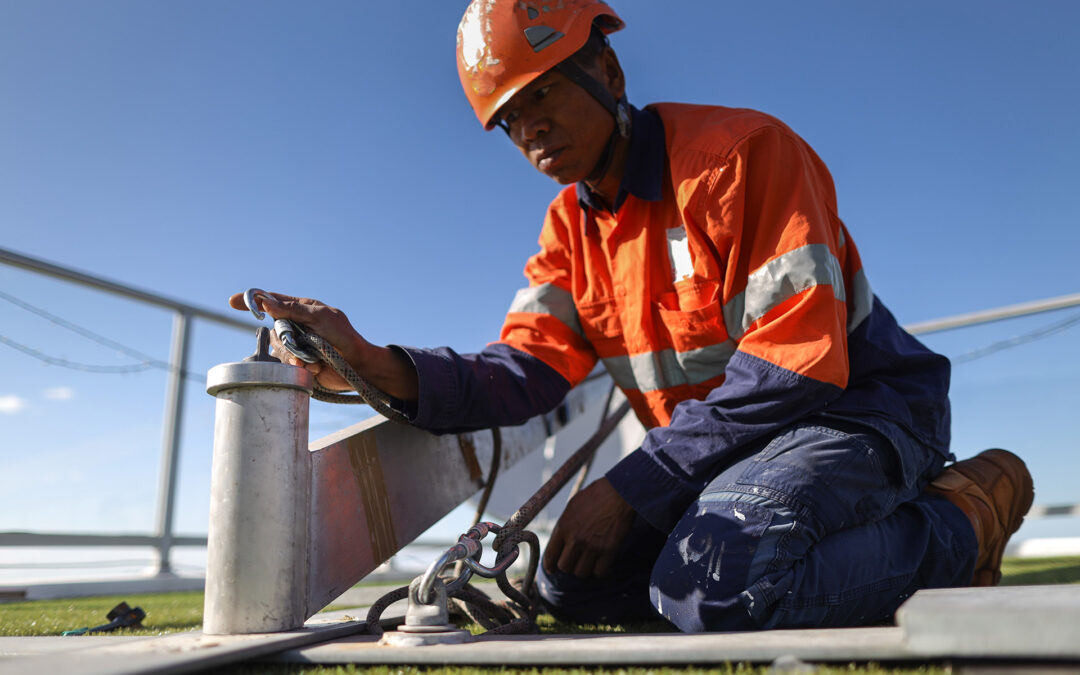
The WAHS RS Anchor Device is a 6 mm stainless steel anchor device, chemically bonded to concrete structures using stainless steel anchors. It is engineered specifically to address the orientation and cross-loading problems inherent in standard eyenut installations — with a swivel design that ensures the load-bearing element aligns with the direction of the applied load under all conditions of use.
Every RS Anchor Device installation is supplied with documentation confirming the installation standard, the substrate assessment, and the load ratings — and is subject to annual inspection and recertification as required.
If you are specifying or replacing anchor points on a South African building, the RS Anchor Device is designed and manufactured locally, benchmarked against international standards, and supported by WAHS’s full inspection and certification service.
Summary: What Every Employer Must Verify
Before any work at height is performed using anchor points on your building or construction site, confirm the following:
- Installation competence: Was the anchor point selected, installed, and tested by a person with IWH-recognised anchor point training — not merely a rope access or general safety qualification?
- Substrate: Is the anchor installed into in-situ cast concrete of at least grade C20/25? Not plaster, brick, or precast block?
- Load rating: Does the anchor point have a minimum working load of 600 kg for fall arrest use? M12 eyenuts do not meet this requirement.
- Orientation: Is the anchor point design such that it aligns with the direction of the applied load? Rigid eyenuts on set chemical anchors cannot achieve correct orientation reliably.
- Inspection currency: Has the anchor point been inspected and certified within the last 12 months, with a written record held on file?
If you cannot confirm all five, contact WAHS for an anchor point audit before work commences.
Get Expert Advice on Your Anchor Points
WAHS conducts anchor point audits, inspections, and certifications across South Africa. Contact us to discuss your building’s compliance status.
Get a Quote
Speak to a specialist about your work at height requirements. Complete the form below and we will get back to you promptly.
Published by Jaco Coetzer | Work at Height Solutions (Pty) Ltd
Trackbacks/Pingbacks