
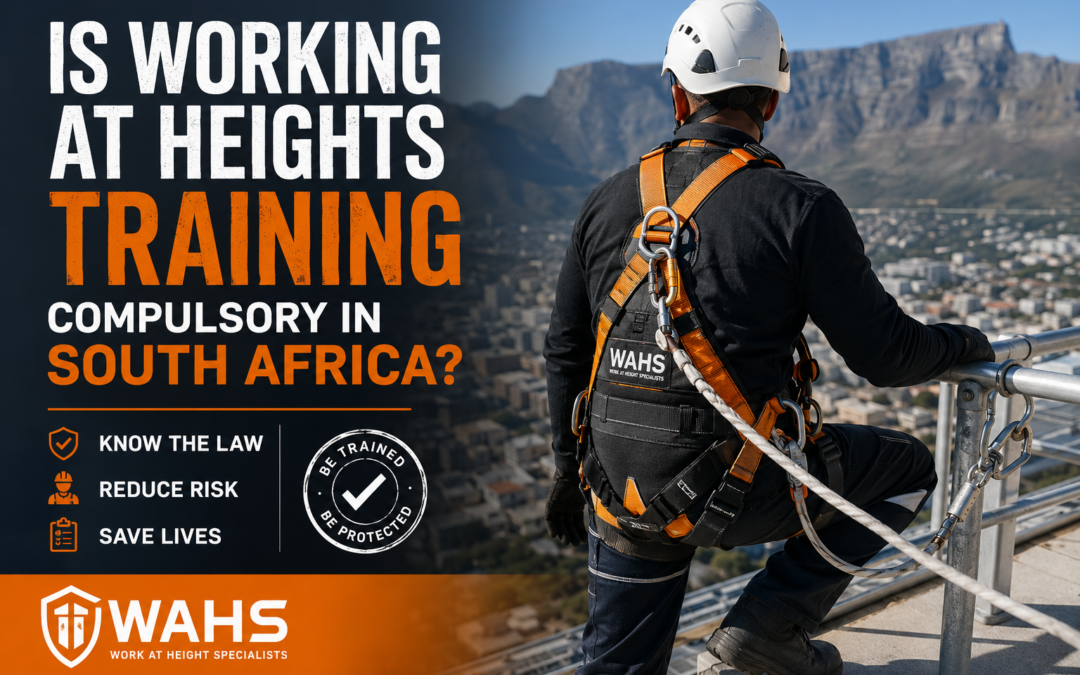
Working at heights training is compulsory when an employee’s duties expose them to a fall risk and training is necessary for that person to perform the work safely. However, there is no single course that automatically covers every type of work at height. The training must match the work being performed, the equipment being used and the employee’s responsibilities.
Giving an employee a harness and showing them where to connect it is not enough. Before a person enters a fall-risk position, the employer must ensure that the hazards have been assessed, suitable controls are in place and the employee is competent to use the selected system.
What does South African law require?
Section 8 of the Occupational Health and Safety Act places a general duty on employers to provide and maintain, as far as reasonably practicable, a working environment that is safe and without risk to employees.
This duty includes identifying hazards, establishing safe systems of work and providing the information, instruction, training and supervision needed for employees to work safely.
Where the activity falls within the scope of the Construction Regulations, the requirements become more specific. Construction Regulation 10 requires a contractor to prepare and implement a Fall Protection Plan for work where a person may fall.
The Fall Protection Plan must address matters such as:
- The fall hazards associated with the work
- The equipment and systems that will be used
- The training and competency of the people involved
- Medical fitness requirements
- Equipment inspection and maintenance
- Emergency and rescue arrangements
The legal requirement is therefore not merely to issue a certificate. The employer must ensure that each person has the knowledge, practical ability and supervision needed for the work assigned to them.
Is there a minimum height at which training becomes compulsory?
People often assume that working at heights requirements only begin at two metres or three metres. This is not a safe way to determine whether protection or training is required.
The more important question is whether the person will enter a fall-risk position where a fall could cause injury.
A serious injury can occur from a relatively low height, particularly when a person is working:
- Near an open edge
- Above machinery or equipment
- Above reinforcing steel or other projections
- On a fragile roof surface
- Near an excavation or opening
- From a ladder or mobile access tower
- In an area where there is limited fall clearance
The employer’s risk assessment and Fall Protection Plan must determine the controls and training required for the actual hazard. A fixed height should not be used as an excuse to ignore an obvious fall risk.
Who needs working at heights training?
Training is required for employees whose duties expose them to fall hazards or require them to use work-at-height equipment and systems.
This may include:
- Roof workers
- Maintenance technicians
- Solar-panel installers
- Telecommunications technicians
- Steel erectors
- Electricians
- Signage and billboard installers
- People using fall-arrest systems
- People using horizontal or vertical lifelines
- Temporary suspended-platform operators
- Aluminium access-tower users and erectors
- Supervisors responsible for work in fall-risk positions
The correct training will not be identical for every person on this list. An employee who uses a pre-installed lifeline has different responsibilities from a person who installs a fall-arrest system, performs a rescue or prepares a Fall Protection Plan.
What is covered in basic fall arrest training?
Basic fall arrest training is intended for employees who perform work in a fall-risk position under suitable supervision.
A practical course should teach the learner how to:
- Understand the purpose and limitations of fall-arrest equipment
- Inspect a harness, lanyard, connectors and related equipment
- Fit and adjust a full-body harness correctly
- Select and use suitable connection points
- Use a double lanyard while maintaining continuous attachment
- Use pre-installed horizontal and vertical lifelines
- Recognise insufficient fall clearance
- Understand swing-fall and pendulum risks
- Recognise the risks of suspension after a fall
- Follow the applicable Fall Protection Plan
WAHS offers a one-day Fall Arrest when Working at Height course for people who need to perform work in a fall-risk position under supervision.
Is basic fall arrest training enough for every job?
No. Basic training may be suitable for a person using a limited range of equipment under supervision, but it does not make that person competent to perform every work-at-height activity.
Additional or different training may be required where a person must:
- Install a fall-arrest system
- Perform a rescue
- Select or plan anchor points
- Prepare a Fall Protection Plan
- Supervise work at height
- Erect an aluminium access tower
- Operate or erect a temporary suspended platform
- Use rope-access techniques
- Operate a mobile elevating work platform
The training must follow the person’s actual job function. A general “working at heights” certificate should not be treated as proof that the holder is competent in unrelated equipment or specialised access systems.
What is the difference between fall arrest and rescue training?
Fall arrest training teaches a person how to use equipment intended to stop a fall before the person reaches a lower level or obstruction.
Rescue training goes further. It prepares competent personnel to install and inspect systems, implement rescue procedures and recover a person who is suspended following a fall or incident.
A rescue plan cannot rely only on calling the emergency services. A suspended worker may need to be recovered quickly, and the rescue method must be suitable for the site, equipment and location.
WAHS provides a two-day Fall Arrest Rescue course covering system installation, inspection, Fall Protection Plan implementation and basic fall-arrest rescue.
Do supervisors need different training?
Yes. A supervisor must understand more than the basic use of a harness and lanyard.
Depending on the work, the supervisor may need to understand:
- The site-specific Fall Protection Plan
- The limitations of the selected access method
- Anchor-point and lifeline restrictions
- Equipment inspection requirements
- Fall clearance
- Weather and environmental limitations
- Exclusion zones
- Rescue readiness
- When work must be stopped
A supervisor must be competent for the equipment and activity being controlled. Appointing someone as a supervisor does not create competence unless that person has the necessary knowledge, training and experience.
Do employees need to be medically fit?
Medical fitness is an important part of work-at-height planning. A person may have a condition that affects balance, consciousness, physical mobility or the ability to work safely while wearing fall-protection equipment.
Where construction work is involved, the Fall Protection Plan must consider the medical fitness of employees who work in fall-risk positions.
The required assessment should be completed by an appropriate occupational health practitioner and should be relevant to the person’s work and exposure. A normal general medical examination may not necessarily address the particular demands of work at height.
Can working at heights training be completed online?
Online learning can be useful for theory, inductions and refresher information, but it cannot by itself demonstrate that a learner can safely inspect, fit and use fall-protection equipment.
Practical competence normally requires the learner to physically demonstrate tasks such as:
- Inspecting equipment
- Fitting and adjusting a harness
- Using connectors correctly
- Maintaining continuous attachment
- Moving between anchor points or systems
- Using a lifeline
- Responding to an emergency scenario
Employers should be cautious of certificates issued after a short online presentation with no practical assessment. A certificate is only useful if it represents genuine competence for the work the employee must perform.
How long is a working at heights certificate valid?
Employers should not rely only on an expiry date printed on a certificate. Competence must be maintained and should be reviewed whenever circumstances indicate that a person may no longer be able to perform the work safely.
Refresher training or reassessment may be required when:
- The employer’s Fall Protection Plan specifies a refresher period
- A client or site standard requires it
- The equipment or system changes
- The person has not performed the task for an extended period
- Unsafe behaviour or poor technique is observed
- An incident or near miss occurs
- The work method or site conditions change
- The person cannot demonstrate continued competence
A current certificate does not excuse an employer from intervening when a worker is using equipment incorrectly.
Is a harness certificate the same as working at heights training?
No. A harness is only one component of a fall-protection system.
A person must also understand:
- Whether the system prevents or arrests a fall
- Where connection is permitted
- Whether the anchor is suitable
- How much fall clearance is available
- How the lanyard or lifeline will behave during a fall
- Whether there is a swing-fall risk
- How the person will be rescued
Training that only teaches employees how to wear a harness does not address the full risk.
What records should the employer keep?
The employer should retain records that demonstrate how competence and compliance were managed. These may include:
- Training certificates and assessment records
- Copies of relevant course outcomes
- Medical certificates of fitness
- The site-specific Fall Protection Plan
- Employee appointments and responsibilities
- Equipment inspection registers
- Anchor-point and lifeline records
- Toolbox talks and site inductions
- Rescue drills and emergency arrangements
- Evidence of refresher training or reassessment
These records should support what is happening on site. A well-organised safety file cannot make unsafe work compliant when employees do not understand or follow the system.
How can an employer determine the correct training?
Before booking a general course, the employer should answer the following questions:
- What work will the employee perform?
- Where can the person fall?
- Can the fall risk be eliminated or prevented?
- What access equipment will be used?
- Will the system be fall restraint or fall arrest?
- Who will install and inspect the system?
- Who will supervise the work?
- How will a suspended person be rescued?
- What level of practical competence must the worker demonstrate?
The answers determine whether the employee needs basic fall arrest, fall arrest rescue, Fall Protection Planner, access-tower, ladder, suspended-platform or other specialised training.
Book working at heights training with WAHS
Work at Height Solutions provides practical training for employees, supervisors and personnel responsible for fall-protection systems.
Available programmes include:
- Fall Arrest when Working at Height
- Fall Arrest Rescue
- Fall Protection Planner
- Aluminium Scaffolding User and Inspector
- Ladder User
- Temporary Suspended Platform Operator
- Temporary Suspended Platform Erector
- Temporary Suspended Platform Supervisor
View the WAHS training programmes, or complete the form below for course dates and a quotation.
Frequently asked questions
Is working at heights training legally required in South Africa?
Employees must receive suitable information, instruction, training and supervision where their work exposes them to a fall risk. The precise course required depends on the work, equipment and responsibilities involved.
At what height is working at heights training required?
The decision should be based on the risk of injury from a fall, not only a fixed measurement. Training and protection may be necessary at a relatively low height where a fall could cause injury.
Does every employee need the same working at heights course?
No. A worker using a pre-installed system, a rescue technician, an access-tower erector and a Fall Protection Planner perform different duties and require different competencies.
Can a person work at height with only a harness certificate?
Not necessarily. The employee must be competent in the complete work method and system, including equipment inspection, connection, anchor limitations, fall clearance and emergency arrangements.
Can working at heights training be completed entirely online?
Online theory may support learning, but practical competence in fitting, inspecting and using fall-protection equipment should be demonstrated through practical assessment.
How often should working at heights training be refreshed?
Refresher training should be based on the Fall Protection Plan, workplace requirements and continued competence. Retraining may be needed after an incident, equipment change, extended absence or evidence of unsafe practice.
Is fall arrest training the same as rescue training?
No. Fall arrest training focuses on safely using equipment to prevent or arrest a fall. Rescue training includes the additional skills needed to install systems and recover a suspended casualty.
Published by Jaco Coetzer | Work at Height Solutions (Pty) Ltd