
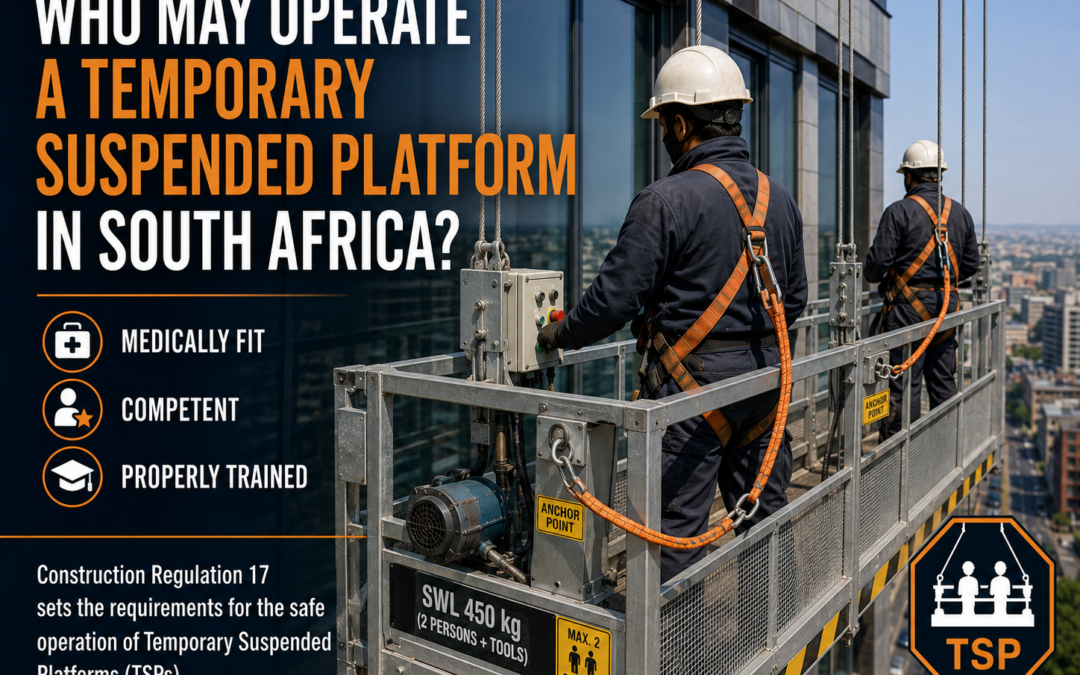
A temporary suspended platform may only be operated by a person who is medically fit, competent and properly trained for suspended-platform work. Construction Regulation 17 places specific duties on the contractor regarding operator competence, training, supervision, daily inspections, fall protection and the safe operation of the equipment.
Simply having general working-at-heights training is not enough. A person who operates a Temporary Suspended Platform (TSP) must understand the platform controls, safety devices, safe access and egress, emergency procedures, equipment defects and correct use of the body harness.
It is also important to distinguish between the three main levels of competence associated with a TSP: the operator, erector and supervisor. These are different functions and should not be treated as interchangeable.
What is a Temporary Suspended Platform?
A Temporary Suspended Platform, commonly referred to as a TSP, is suspended access equipment installed temporarily to provide access to elevated work positions.
The system normally consists of:
- A working platform
- Electric traction hoists
- Suspension wire ropes
- Secondary safety wire ropes
- Safety brakes
- A control box
- Suspension equipment or roof rig
- Required safety devices
TSPs are commonly used for activities such as:
- Building maintenance
- Painting
- Cladding installation
- Façade work
- Repairs
- Construction
- Refurbishment
The system is erected for a particular task and is dismantled and removed once the work has been completed.
What does Construction Regulation 17 require?
Construction Regulation 17 specifically deals with suspended platforms and places detailed legal duties on contractors using this type of equipment.
The regulation addresses matters including:
- Appointment of a competent suspended-platform supervisor
- Competence of operators, erectors and inspectors
- System design and engineering
- Operational Compliance Plans
- Platform stability
- Suspension systems
- Body harnesses and anchorage points
- Testing and inspection
- Daily inspections
- Operator training
- Medical fitness
- Relocation of the suspension system
This makes CR 17 one of the most important legal references when determining whether a person may legally and safely operate a temporary suspended platform.
Who may operate a Temporary Suspended Platform?
Construction Regulation 17(12) requires every employee who works on or is supported by a suspended platform to be:
- Medically fit to work safely in the environment
- Competent to perform suspended-platform work safely
- Properly trained for the work and equipment
In practical terms, a TSP operator should have:
- A valid medical certificate of fitness for work in a fall-risk position
- Working-at-heights competence
- Specific temporary suspended-platform operator training
- Practical knowledge of the particular TSP being used
- Knowledge of the controls and safety devices
- Knowledge of the emergency procedures
- Knowledge of daily safety requirements
- Instructions regarding correct harness use
A person should therefore not be placed on a TSP merely because they have previously worked from one or because another employee showed them which buttons to press.
What training must a TSP operator receive?
Construction Regulation 17(12)(c) specifies the minimum subjects that must be included in the operator’s training.
The training must include at least:
1. Safe access and egress
The operator must know how to enter and leave the suspended platform safely.
As a general operating rule, access and egress should take place when the platform is firmly positioned at ground level.
The operator must not casually climb into or out of a suspended platform from a ladder, window, roof edge or other unsafe position.
2. Correct operation of the controls
The operator must understand how to operate the platform controls correctly.
This includes:
- Raising the platform
- Lowering the platform
- Operating both hoists together
- Operating individual hoists where required
- Using the emergency stop
- Understanding the control selector
The operator must be able to demonstrate practical competence rather than merely describe the controls in theory.
3. Correct operation of safety devices
A TSP incorporates safety devices intended to protect the operators if something goes wrong.
Depending on the particular system, these may include:
- Secondary safety brakes
- Top limit devices
- Overload protection
- Anti-tilt devices
- Emergency stop controls
- No-power descent systems
The operator must understand what these devices do and how to respond when one of them activates.
4. The dangers of misusing safety devices
Safety devices must never be bypassed, tied back, disconnected or interfered with to keep the platform operating.
If a safety device continually activates, there may be a problem with:
- The platform loading
- The hoist
- The wire rope
- The platform level
- The suspension arrangement
- The safety device itself
The correct response is to stop the work and report the problem, not defeat the device.
5. Emergency procedures
The operator must know what to do when an emergency occurs.
This may include:
- Power failure
- Hoist malfunction
- A safety brake activating
- Unexpected platform movement
- A worker becoming injured or incapacitated
- Unsafe weather developing
The operator must understand the emergency procedures before the platform leaves the ground.
6. Procedures when equipment malfunctions
An operator must recognise that unusual noises, jerking, failure of a control, uneven movement or repeated operation of a safety device can indicate a malfunction.
The platform should not continue to be used simply because it can still move.
The operator must stop work and report the problem in accordance with the site and supplier procedures.
7. What to do when a defect is discovered
Operators must know how to respond when they find a suspected defect.
Examples include:
- Damaged wire rope
- Kinked or birdcaged wire rope
- Loose bolts
- Damaged electrical cables
- Faulty controls
- Missing counterweights
- Damaged platform components
- Faulty safety devices
The equipment must not simply be used until it eventually fails.
8. Proper use of the body harness
Construction Regulation 17 specifically requires training in the proper use of body harnesses.
Every person on the platform must understand:
- How to inspect the harness
- How to fit and adjust it correctly
- How to attach the lanyard
- Where the approved anchor point is situated
- Why the harness must remain attached
Must a TSP operator wear a safety harness?
Yes.
Construction Regulation 17(6)(c) requires each person on a suspended platform to be provided with and wear a body harness as a fall-prevention device.
The harness must remain attached while the person is on the suspended platform.
This is not optional because the platform has guardrails. The body harness requirement applies in addition to the physical protection provided by the platform.
Where must the operator attach the harness?
This is one of the most important TSP safety requirements.
Construction Regulation 17(7)(b) requires the suspended platform to be fitted with anchorage points to which workers attach the lanyard of the safety harness.
The anchorage connection must have sufficient strength to withstand the potential load applied to it.
The operator training instructions require the shock-absorbing lanyard to be connected to the identified anchor point inside the platform.
The operator should therefore not attach the lanyard to:
- A guardrail
- A random platform tube
- The control box
- The hoist
- A wire rope
- An electrical cable
- Any convenient component that is not an approved anchor point
The anchor point must be clearly identifiable so that operators know exactly where the harness connection is intended to be made.
Why does the platform need its own harness anchor points?
The platform must provide an intended connection point for the operator’s body harness.
Without a clearly identified anchor point, workers may attach their lanyards to structural members or components that were never designed for that purpose.
This can create a dangerous situation where the worker appears to be attached but the connection may not withstand the forces applied to it.
The TSP supervisor should verify during inspections that the anchor points are present, identifiable and in a suitable condition.
Does every person in the platform need operator training?
Construction Regulation 17(12) applies to all employees required to work or be supported on a suspended platform.
This is important because someone does not avoid the training requirement simply because another person intends to operate the controls.
Every person supported by the platform must be medically fit, competent and trained in the applicable safety requirements.
That includes people performing activities such as:
- Painting
- Cleaning
- Cladding
- Glazing
- Maintenance
- Repairs
- Inspection work
If the person is going to be supported by the TSP, the suspended-platform risks apply to that person.
Does an operator need working-at-heights training as well?
Yes. The operator training instructions require people supported by the platform to be trained and certified competent to work at height as well as trained and competent to operate the TSP.
The two competencies address different risks.
Working-at-heights training covers general fall-protection principles, while the TSP operator programme deals specifically with suspended-platform equipment and operation.
Read our detailed guide explaining when working-at-heights training is compulsory in South Africa.
Does a TSP operator need a medical certificate?
Yes.
Construction Regulation 17(12)(a) requires employees supported on a suspended platform to be medically fit to work safely in the fall-risk environment and to be in possession of a medical certificate of fitness.
The medical assessment should confirm that the employee is fit for the work environment and demands associated with elevated and suspended work.
A training certificate does not replace the medical certificate of fitness.
Who supervises Temporary Suspended Platform work?
Construction Regulation 17(1) requires the contractor to appoint a competent person in writing to ensure that suspended-platform operations are carried out under that person’s supervision.
The supervisor must also ensure that the:
- Erectors are competent
- Operators are competent
- Inspectors are competent
This means a company cannot simply appoint any site supervisor to control a TSP because that person happens to be senior.
The person must have the training, knowledge, practical experience and competency appropriate to temporary suspended platforms.
What training applies to a TSP supervisor?
The formal supervisor programme is aligned with SAQA Unit Standard 243271: Supervise, Inspect and Control the Use of Temporary Suspended Platforms.
The programme is:
- NQF Level 4
- 8 credits
The supervisor function is significantly broader than that of the operator.
A supervisor must understand matters such as:
- Construction Regulation 17
- Different TSP configurations
- System requirements
- Building loads
- Risk assessments
- Fall Protection Plans
- Operational Compliance Plans
- Installation control
- Testing
- Operator competence
- Daily inspections
- Emergency procedures
- Relocation of the TSP
What is the difference between an operator, erector and supervisor?
| Role | Main responsibility |
|---|---|
| TSP Operator | Uses and works from the suspended platform safely, understands controls, safety devices, emergency procedures and harness requirements. |
| TSP Erector | Installs, assembles, relocates and dismantles temporary suspended-platform equipment within the approved system and Operational Compliance Plan. |
| TSP Supervisor | Supervises, inspects and controls the installation and use of the system and confirms the competence of operators, erectors and inspectors. |
These competencies build on each other but should not be confused.
An operator certificate does not qualify a person to alter the roof rig. An erector does not automatically become the appointed supervisor. The supervisor must have the higher level of knowledge required to control the overall TSP operation.
May an operator move or alter the suspension rig?
No. A TSP operator should not alter, relocate or dismantle the suspension rig unless that person has the necessary additional erection competence and the work is performed under the required supervision.
Construction Regulation 17(13) specifically requires that where outriggers are moved, only trained persons under the supervision of the competent person perform the move.
The relocation must remain within the limitations of the Operational Compliance Plan.
After relocation, the competent supervisor must inspect the system and record the results before the platform is used again.
What is an Operational Compliance Plan?
Construction Regulation 17 requires an Operational Compliance Plan before suspended-platform work begins.
The plan is based on the approved system design and must provide evidence of important compliance matters such as:
- Appointment of the competent supervisor
- Competency of erectors
- Competency of operators
- Competency of inspectors
- Operational design calculations
- Performance test results
- System sketches
- Platform loading capacity
- Inspection procedures and records
- Maintenance procedures and records
The TSP should therefore not be viewed as simply a platform that is delivered to site and switched on.
Its safe use depends on the complete installation, engineering, training, supervision, inspection and compliance system.
Does the platform need to be inspected every day?
Yes.
Construction Regulation 17(10) requires the suspended-platform supervisor or suspended-platform inspector to conduct a daily inspection before the equipment is used.
The daily inspection must establish, among other things, whether:
- All connection bolts are secure
- All safety devices are functioning
- Safety devices have not been tampered with
- The maximum platform load is not being exceeded
- The occupants are wearing properly attached body harnesses
- There are visible signs of equipment damage
- Reported operating problems have been addressed
A platform should not be used simply because it operated correctly the previous day.
What should the operator check before using the platform?
The formal daily inspection is the responsibility of the designated competent person, but operators must also remain alert to the equipment they are using.
Before operation, the operator should confirm that:
- The required inspection has been completed
- The platform appears complete and undamaged
- The harness is correctly fitted
- The lanyard is attached to the correct anchor point
- The rated load will not be exceeded
- The controls operate correctly
- The emergency stop is functional
- The safety devices have not been bypassed or altered
- There are no obvious electrical defects
- The work area is suitable
- Weather conditions remain safe
If anything appears abnormal, the correct action is to stop and report the problem.
What is the Safe Working Load of the platform?
The platform has a rated maximum load which must not be exceeded.
The total load includes:
- The operators
- Tools
- Materials
- Equipment
- Anything else carried on the platform
The maximum permitted load and number of persons must be clearly displayed on the platform.
The operator must understand that adding building materials, paint, equipment or debris can quickly increase the load even when the number of people remains unchanged.
Can a ladder be used inside the platform to gain extra height?
No. Operators must not place ladders, boxes, drums or other objects on the platform to increase their working height.
This can:
- Place the worker above the guardrails
- Create instability
- Increase the risk of falling
- Interfere with platform operation
- Change the loading on the system
If the platform cannot safely reach the required work position, the access method or installation must be reassessed.
Can a TSP be operated in strong wind or rain?
The operator must consider weather conditions continuously.
The operating instructions prohibit the use of the TSP during unsafe weather such as:
- Rain
- Lightning
- Strong winds that cause the platform to sway
Operators must never allow pressure to complete a task to override obvious changes in the safety of the work environment.
What happens if a safety device trips?
A safety device activating is an indication that the operator must identify what has happened before continuing.
The platform must not simply be forced to continue operating.
Depending on the situation, the operator may need to:
- Stop the platform.
- Assess the condition of the system.
- Follow the emergency or malfunction procedure.
- Inform the supervisor.
- Prevent further use until the cause is understood.
An operator must never bypass the safety device to get the platform moving again.
What happens when a defect is found?
If a defect is identified, the use of the TSP must be suspended until the problem has been properly assessed and corrected.
Examples of defects that require attention include:
- Damaged wire ropes
- Kinked wire ropes
- Birdcaging
- Loose connections
- Electrical damage
- Faulty hoists
- Faulty safety brakes
- Missing or altered safety components
The operator should not attempt unauthorised repairs or alterations.
What records should be available on site?
A compliant suspended-platform operation requires more than operator certificates.
Depending on the installation, site records should include relevant documentation such as:
- Appointment of the suspended-platform supervisor
- Proof of operator competence
- Proof of erector competence
- Medical certificates of fitness
- Certificate of system design
- Operational Compliance Plan
- Performance test records
- Installation sketches
- Inspection records
- Maintenance records
- Daily inspection records
Construction Regulation 17 requires inspection and performance test records to be kept on the construction site and made available when requested.
Common TSP operator compliance mistakes
Common problems include:
- Allowing untrained workers onto the platform
- Relying only on general working-at-heights training
- Operating without a valid medical certificate
- Operators not wearing body harnesses
- Connecting lanyards to the guardrail instead of the designated anchor point
- Operating without a daily inspection
- Allowing operators to move or alter the suspension rig
- Exceeding the Safe Working Load
- Using ladders or boxes on the platform
- Bypassing safety devices
- Ignoring damaged wire ropes
- Continuing work in unsafe weather
- Failing to stop work after discovering a defect
Book Temporary Suspended Platform training
Work at Height Solutions provides training for the different competency levels required for temporary suspended-platform operations.
Training includes:
- Temporary Suspended Platform Operator
- Temporary Suspended Platform Erector
- Temporary Suspended Platform Supervisor
The programmes address the different responsibilities of the people who operate, install and supervise these systems.
View the WAHS training programmes or complete the form below for training dates, on-site courses and a quotation.
Frequently asked questions
Who may operate a Temporary Suspended Platform in South Africa?
A person operating or working from a TSP must be medically fit, competent and properly trained in the use and safety requirements of temporary suspended platforms.
Does a TSP operator need specific training?
Yes. Construction Regulation 17 requires training in safe access and egress, controls, safety devices, misuse of safety devices, emergency and malfunction procedures, suspected defects and proper body-harness use.
Does every person working on the platform need training?
Yes. Construction Regulation 17 applies to all employees required to work or be supported on the suspended platform, not only the person operating the controls.
Does a TSP operator need a medical certificate?
Yes. The person must be medically fit for work in the fall-risk environment and possess the required medical certificate of fitness.
Must a TSP operator wear a harness?
Yes. Every person on the suspended platform must wear a body harness and remain properly attached while on the platform.
Where must the TSP operator attach the harness?
The lanyard must be attached to the designated anchorage point provided on the suspended platform. It must not be connected to a random guardrail or other component.
Can a TSP operator move the roof rig?
Not unless the person has the required additional training and competence. Relocation of outriggers must be carried out by trained persons under the supervision of the competent person and within the Operational Compliance Plan.
Who supervises TSP operations?
The contractor must appoint a competent person in writing to supervise suspended-platform work and ensure that the operators, erectors and inspectors are competent.
What qualification applies to a TSP supervisor?
The formal supervisor programme is aligned with SAQA Unit Standard 243271, Supervise, Inspect and Control the Use of Temporary Suspended Platforms, at NQF Level 4 with 8 credits.
Must a TSP be inspected every day?
Yes. The suspended-platform supervisor or inspector must carry out a daily inspection before the equipment is used.
Published by Jaco Coetzer | Work at Height Solutions (Pty) Ltd