
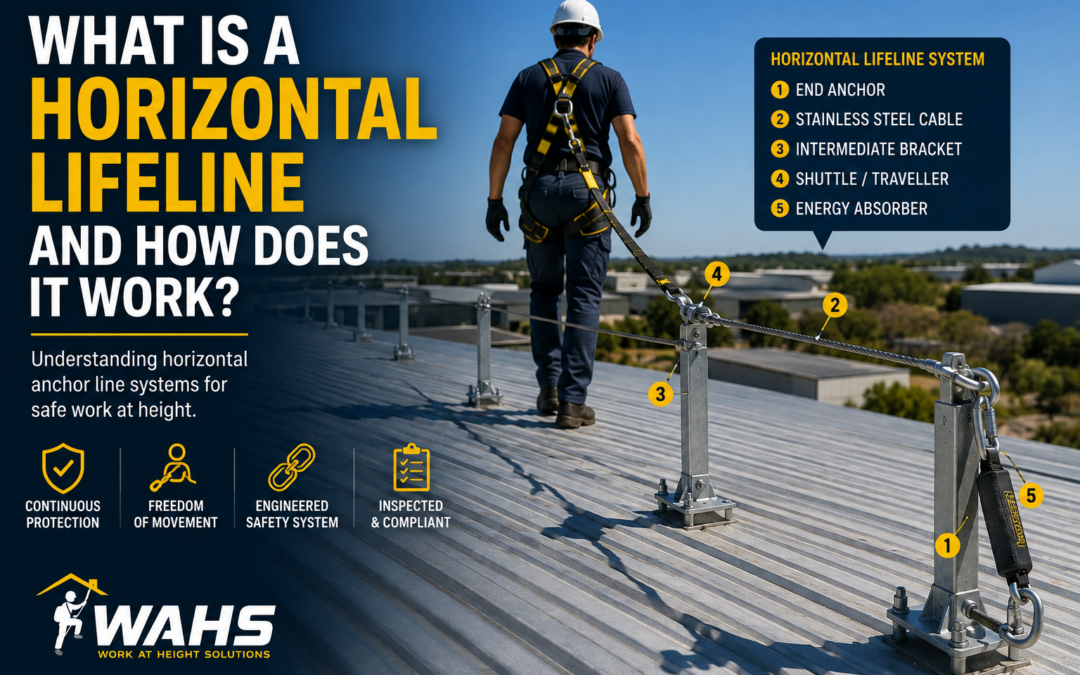
A horizontal lifeline is an engineered fall-protection system that allows a worker to remain connected while moving horizontally along a roof, elevated structure or other exposed work area. It normally consists of end anchors, a cable or flexible anchor line, intermediate supports, a travelling attachment device and components that control the forces generated during a fall.
The cable alone is not the lifeline system. The supporting structure, anchors, brackets, tensioning components, energy absorber, connectors and personal fall-protection equipment must all work together as one compatible system.
A horizontal lifeline can provide valuable freedom of movement, but it must be properly selected, designed, installed, inspected and used. A cable stretched between two convenient points does not automatically become a compliant lifeline.
What is a horizontal lifeline?
A horizontal lifeline is a flexible anchor system installed across or along a work area. A worker connects a harness and suitable connecting device to the line, normally through a travelling shuttle or attachment point.
The system allows the worker to move along the line while remaining connected. Depending on its design, the line may be used for:
- Fall restraint
- Fall arrest
- Work positioning in certain specifically designed applications
These uses are not interchangeable. A system designed only to prevent a person from reaching an edge must not automatically be treated as suitable for arresting a fall.
Is a horizontal lifeline the same as an anchor line?
The terms are often used interchangeably in everyday conversation. You may also hear people refer to a:
- Horizontal anchor line
- Static line
- Roof safety line
- Fall-arrest cable
- Safety lifeline
Although the wording differs, the important issue is the system’s declared purpose and design.
A line used for fall restraint may be configured to prevent a person from reaching a fall-risk position. A fall-arrest line must be capable of controlling the forces and movement resulting from an actual fall.
The system documentation should clearly state:
- Its intended use
- The permitted number of users
- The compatible personal protective equipment
- Any limitations on span length or user position
- Required fall clearance
- Inspection and maintenance requirements
How does a horizontal lifeline work?
The worker wears a suitable full-body harness and connects to the lifeline using equipment selected for the system and the work method.
As the worker moves, the connector or shuttle travels along the line. On systems with intermediate brackets, a suitable travelling device may allow the worker to pass the brackets without disconnecting.
If the system is being used for fall restraint, the equipment should prevent the worker from reaching the point from which a fall can occur.
If the system is designed for fall arrest and the worker falls, several things happen:
- The worker’s connecting equipment begins arresting the fall.
- The lifeline deflects under the load.
- Energy-absorbing components help control the force.
- The end anchors and supporting structure resist the loads transferred into them.
- The system stops the fall before the worker reaches the ground, a lower level or another obstruction.
This is why a lifeline cannot be assessed by looking only at the breaking strength of the cable. The behaviour of the complete system during a fall must be considered.
What are the main parts of a horizontal lifeline system?
The exact components depend on the manufacturer and design, but a permanent horizontal lifeline commonly includes:
- End anchors: The points at which the line terminates and transfers forces into the structure.
- Intermediate brackets: Supports that guide the line and help control the span.
- Flexible anchor line: Usually a purpose-designed wire rope or other approved line.
- Tensioning device: Used to set and maintain the specified line tension.
- Energy absorber: Helps limit the forces transferred into the system and structure.
- Traveller or shuttle: The mobile connection point that moves along the line.
- Identification plate: Records the system’s purpose, limitations and inspection information.
- Personal connection equipment: The harness, lanyard or other compatible device used by the worker.
Removing, replacing or changing one component may affect the performance of the complete system. Components from different systems should not be mixed unless their compatibility has been confirmed.
Where are horizontal lifelines commonly used?
Horizontal lifelines are commonly installed where workers need to move across or along an exposed area while remaining connected.
Typical applications include:
- Commercial and industrial roofs
- Roof plant and mechanical equipment areas
- Loading bays
- Crane runways
- Truck and tanker loading areas
- Aircraft maintenance facilities
- Warehouses
- Bridges and elevated structures
- Maintenance walkways
- Solar-panel installations
A lifeline should not be installed simply because work takes place at height. The correct solution may instead be edge protection, a walkway, guardrails, individual anchor points, a mono-rail, a mobile elevating work platform or another access system.
The first objective should always be to eliminate or prevent the fall risk where reasonably practicable.
What is the difference between fall restraint and fall arrest?
Fall restraint is intended to prevent the worker from reaching the position from which a fall can occur.
Fall arrest allows the possibility of a fall but stops the person before they strike the ground, a lower level or another obstruction.
A restraint system generally exposes the worker and the structure to lower forces because the person should not fall. A fall-arrest system must control the forces, movement and clearance involved in stopping a falling person.
Where practical, fall restraint is normally preferable because it prevents the fall from occurring.
Read more about the distinction in our guide to fall arrest and fall prevention.
Why does a horizontal lifeline deflect during a fall?
A flexible lifeline does not remain perfectly straight when loaded. During a fall, the line deflects and the worker may travel farther below the line before the fall is fully arrested.
The amount of movement can be affected by:
- The length of the lifeline span
- The initial line tension
- The position of the worker along the span
- The number of connected workers
- The type of energy absorber
- The connecting equipment being used
- The distance of the potential free fall
- The system manufacturer’s design
Longer spans can create significant line deflection. This must be included in the fall-clearance calculation.
What is fall clearance?
Fall clearance is the unobstructed vertical distance required beneath the worker so that the complete fall-arrest system can stop a fall safely.
The calculation may need to allow for:
- The free-fall distance
- Deployment of the energy absorber
- Lifeline deflection
- Stretch or movement in the connecting equipment
- The worker’s height and harness attachment position
- A suitable safety margin
A horizontal lifeline may be structurally strong enough but still be unsafe where there is insufficient clearance below the worker.
This is particularly important on low roofs, mezzanines, loading areas and structures where machinery, steelwork or other obstructions are located below the work position.
What is swing-fall risk?
A swing fall, sometimes called a pendulum fall, can occur when a worker falls from a position that is horizontally offset from the point of connection.
Instead of falling directly beneath the connection point, the worker may swing sideways and strike:
- A wall
- A column
- Structural steelwork
- Machinery
- A lower roof
- Another obstruction
The layout of the lifeline and the worker’s permitted movement must therefore be planned to control both vertical fall distance and sideways movement.
How many workers can use one horizontal lifeline?
There is no universal answer. The maximum number of users must be determined by the design and declared capacity of the specific system.
A system intended for one person must not be used by several people simply because there is enough physical space on the cable.
Adding users can increase:
- The loads applied to the end anchors
- The load transferred into the supporting structure
- Line deflection
- The required fall clearance
- The risk of workers colliding during a fall
- The complexity of the rescue operation
The system identification plate and technical documentation should state the maximum permitted number of users.
Can any steel cable be used as a horizontal lifeline?
No. A normal steel cable does not become a fall-protection system merely because it appears strong.
A proper lifeline system requires:
- Suitable and traceable components
- Designed end connections
- Compatible intermediate brackets
- Controlled line tension
- Consideration of energy absorption
- Verified structural support
- Defined user limitations
- Installation and inspection records
An improvised line may transfer dangerously high forces into the anchors or structure. It may also deflect more than expected or fail at a termination, bracket or connection.
Can a lifeline be attached directly to roof sheeting?
A lifeline should only be attached through a system and fixing arrangement that has been designed and approved for the roof construction and intended use.
Roof sheeting by itself is generally not the same as the supporting structure. The suitability of the complete load path must be established, including:
- The lifeline bracket
- The fixing method
- The roof sheet or seam
- The purlin or supporting member
- The structural connections
- The condition of the existing roof
A successful pull on a single fixing does not necessarily prove that the roof structure or complete system can withstand the loads created during a fall.
For more information on this issue, read why many anchor points fail the design test.
Why must the supporting structure be assessed?
The loads generated by a horizontal lifeline are transferred into its end anchors and supporting structure. These forces may act horizontally, vertically or in combination, depending on the layout and fall event.
The structure must therefore be suitable for the system and its intended use.
The assessment may need to consider:
- The material and condition of the structure
- The load path through the building
- The spacing and position of anchors
- The forces generated at the end anchors
- The capacity of bolts, welds and other connections
- The number of permitted users
- The effect of corrosion or deterioration
- The possibility of simultaneous falls
A strong cable connected to unsuitable steelwork, weak roof members or unverified fixings does not provide a safe system.
Who may design and install a horizontal lifeline?
The system should be designed and installed by people who are competent for the specific product, structure and fall-protection application.
Competence should include more than the ability to fix brackets and tension a cable. The people responsible should understand:
- Fall-protection principles
- System limitations
- Structural load transfer
- Fall clearance
- Installation tolerances
- Component compatibility
- Inspection requirements
- Rescue implications
Where structural design or verification is required, it must be completed by an appropriately competent professional.
WAHS designs and installs fall-prevention and fall-protection safety systems for buildings and industrial facilities.
What documents should be supplied with a lifeline installation?
The documentation will depend on the system and project, but a properly completed installation should normally be supported by records such as:
- System layout or as-installed drawing
- Identification of the product and components
- The declared purpose of the system
- The maximum permitted number of users
- Compatible personal protective equipment
- Installation and commissioning records
- Structural design or verification where applicable
- User instructions and limitations
- Inspection and maintenance requirements
- Rescue considerations
- Details of the installer and responsible competent persons
The system should also be clearly identified so that users and inspectors can determine what it is, how it may be used and when it was last inspected.
How often must a horizontal lifeline be inspected?
The inspection frequency must be determined from the legal requirements, the Fall Protection Plan, the manufacturer’s instructions, the system design, site conditions and the nature of the work.
Different levels of inspection may be required:
Pre-use checks
Before connecting, the user should check for obvious problems such as damage, corrosion, loose components, unauthorised alterations or a missing system label.
Formal periodic inspections
A competent person should inspect the system at the required intervals and record the findings. The inspection should cover more than the visible cable and should include the anchors, brackets, fixings, tension, energy absorber and supporting structure where applicable.
Inspection after an incident
A system that has arrested a fall, sustained an abnormal load or been damaged must be removed from service until it has been properly assessed.
Inspection after building work or alteration
Roof replacement, waterproofing, plant installation, structural modification and other building work can damage or alter a lifeline. The system should be inspected before it is returned to service.
What happens after a lifeline arrests a fall?
The system must not simply be used again because it still appears intact.
A fall may have affected:
- The energy absorber
- The cable or flexible line
- The end anchors
- Intermediate brackets
- Fixings and connections
- The supporting structure
- The worker’s harness and connecting equipment
The affected system must be isolated and assessed by a competent person. Components may need to be replaced, and the structure may require further inspection or verification.
Does a horizontal lifeline require a rescue plan?
Yes, where the system is used for fall arrest, a suitable rescue method must be established before the work begins.
Stopping the fall is only the first part of the emergency. The suspended person must then be recovered safely.
The rescue plan should consider:
- Where the worker may be left suspended
- Whether the worker could fall over an edge
- How rescuers will reach the casualty
- What rescue equipment is required
- Whether the rescuer can remain protected
- How the casualty will be raised or lowered
- How emergency services will access the area
- Whether the rescue can be completed promptly
A plan that simply says “call the fire brigade” may not address the immediate risks of suspension or the practical difficulty of accessing the casualty.
How does the Fall Protection Plan apply?
Where the Construction Regulations apply, the horizontal lifeline must form part of the site’s Fall Protection Plan.
The plan should address:
- Why the lifeline was selected
- Whether it is used for restraint or arrest
- Who may use it
- The required training and supervision
- The compatible harnesses and connecting equipment
- The number of permitted users
- Fall-clearance limitations
- Inspection and maintenance
- Rescue procedures
For a detailed explanation, read our guide to Construction Regulation 10 and Fall Protection Plans.
Do workers need training to use a horizontal lifeline?
Yes. The worker must understand the specific lifeline system and the personal protective equipment used with it.
Training should cover:
- Pre-use inspection
- Permitted connection methods
- Use of the traveller or shuttle
- Passing intermediate brackets
- Maximum user limits
- Restricted areas
- Fall clearance
- Swing-fall hazards
- Emergency procedures
- Actions to take when a defect is found
A general harness certificate does not necessarily prove that the employee understands the particular lifeline installed at the site.
WAHS provides practical fall-arrest and work-at-height training for employees who use pre-installed horizontal and vertical lifeline systems.
When is a horizontal lifeline not the correct solution?
A lifeline may not be appropriate where:
- There is insufficient fall clearance
- The supporting structure cannot accept the loads
- Workers can be protected by guardrails or another collective system
- The line would encourage workers to enter an unnecessary fall-risk position
- A swing fall could cause serious injury
- The system cannot provide access to all required work areas
- A safe rescue cannot be performed
- The intended work requires rope-access or work-positioning equipment
The correct fall-protection solution should be selected through a proper risk assessment, not by choosing equipment from a catalogue before the work method is understood.
Horizontal lifeline design and installation
Work at Height Solutions assesses, designs and installs fall-protection systems for commercial buildings, industrial facilities and elevated work areas.
Our services include:
- Site and fall-risk assessments
- Horizontal and vertical lifeline systems
- Fall-restraint and fall-arrest systems
- Individual anchor points
- Mono-rail systems
- Structural assessment and system design
- Installation and certification
- System inspections
- Fall Protection Plans
- User and fall-arrest training
Complete the form below to request an assessment or quotation for a horizontal lifeline system.
Frequently asked questions
What is a horizontal lifeline?
A horizontal lifeline is an engineered flexible anchor system that allows a worker to move horizontally while remaining connected to a fall-protection system.
Is a lifeline the same as an anchor line?
The terms are often used interchangeably. The important distinction is whether the system is designed for fall restraint, fall arrest or another specific purpose.
How many workers can use one horizontal lifeline?
The permitted number of users depends on the design and declared capacity of the specific system. The system identification and technical documentation should state the maximum number of users.
Can an ordinary steel cable be used as a lifeline?
No. A fall-protection lifeline requires engineered anchors, suitable components, controlled tension, structural support, declared user limitations and proper installation.
Can a horizontal lifeline be attached to roof sheeting?
Only where the complete fixing arrangement and supporting roof structure have been designed and verified for the particular lifeline system and intended use.
Why does a horizontal lifeline need fall-clearance calculations?
The line deflects under load. The calculation must consider line deflection, free-fall distance, energy-absorber deployment, connecting-equipment movement, the worker’s height and a suitable safety margin.
How often must a horizontal lifeline be inspected?
The interval must follow the Fall Protection Plan, manufacturer’s instructions, system design, applicable requirements and site conditions. Users must also perform pre-use checks, and the system must be assessed after a fall or abnormal load.
What happens to a lifeline after it arrests a fall?
The system must be isolated and assessed by a competent person. Components may need replacement, and the anchors and supporting structure may require further inspection.
Do workers need training to use a lifeline?
Yes. Workers must understand the system’s purpose, permitted connection methods, user limitations, fall-clearance restrictions, inspection requirements and emergency procedures.
Does a horizontal lifeline need a rescue plan?
Where the system is used for fall arrest, a practical rescue procedure must be prepared before work begins so that a suspended worker can be recovered safely.
Published by Jaco Coetzer | Work at Height Solutions (Pty) Ltd