
If you manage or supervise construction activity in South Africa, the term “competent person” will appear throughout your safety file, your fall protection plan, and any correspondence with a Department of Employment and Labour inspector. Yet it is one of the most consistently misunderstood requirements on construction sites — and getting it wrong carries direct legal exposure for both the employer and the individual who assumed the role without meeting its requirements.
This post sets out exactly what the Construction Regulations 2014 require of a competent person, which specific duties the designation attaches to, and how formal training against the relevant SAQA unit standards satisfies the legal standard.
The Legal Definition: What the Construction Regulations 2014 Actually Say
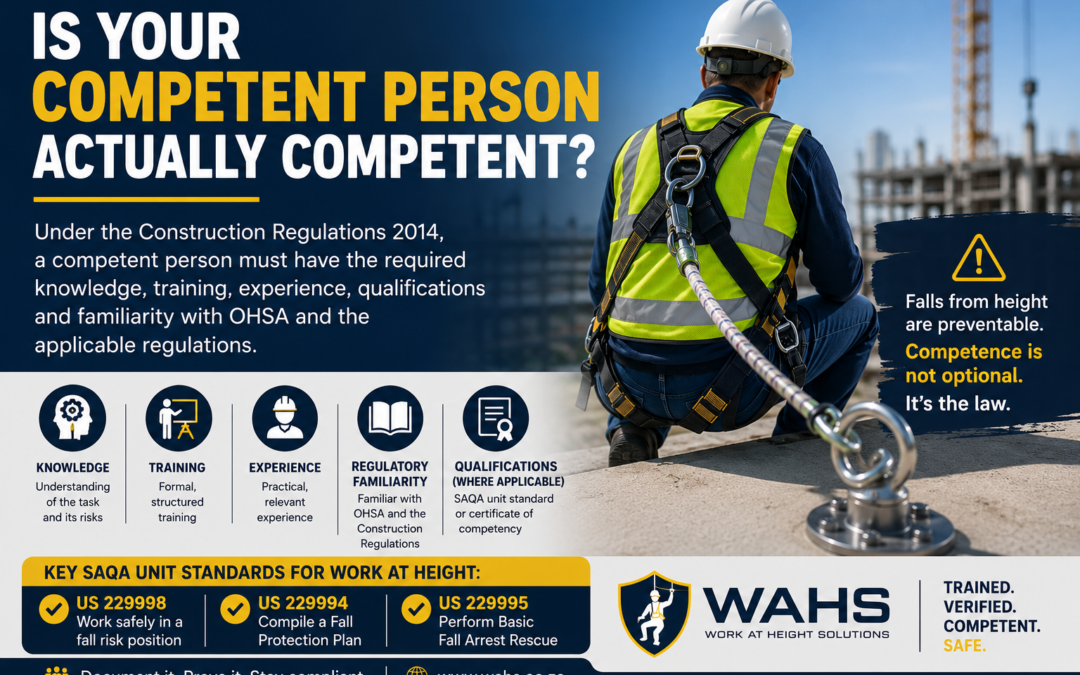
The Construction Regulations 2014, promulgated under the Occupational Health and Safety Act 85 of 1993 (OHSA), define a competent person as follows:
“a person who has in respect of the work or task to be performed the required knowledge, training and experience and, where applicable, qualifications specific to the work or task being performed, and who is familiar with the Act and the applicable regulations made thereunder.”
This definition has four distinct components, all of which must be satisfied simultaneously:
- Knowledge — the person must understand the technical subject matter of the task.
- Training — formal, structured training must have taken place — not merely on-the-job exposure.
- Experience — the person must have practical, verifiable experience relevant to the specific task.
- Familiarity with the Act and regulations — the person must know what OHSA and the Construction Regulations require, not just how to perform the task.
Where the regulations also specify qualifications — and for fall protection work, they do — a certificate of competency or SAQA-registered qualification is not optional. It is part of what constitutes competence under the law.
Why the Competent Person Requirement Exists
The duty of care framework in OHSA is built on the principle that risk must be managed by someone who is genuinely capable of doing so. Section 8 of OHSA places a general duty on every employer to provide a working environment that is safe and without risk to health — as far as is reasonably practicable. The Construction Regulations sharpen this obligation by attaching it to specific, named roles and tasks.
The competent person requirement is the mechanism by which that sharpened obligation is enforced. It removes the defence of ignorance: if you designate someone to a safety-critical role, the regulations hold you accountable for ensuring that the designation is legitimate.
For work at height specifically, the consequences of non-compliance are severe. Falls from elevation consistently rank among the leading causes of fatal occupational injuries in South Africa. A Department of Employment and Labour inspector arriving on site has the authority to issue a prohibition notice stopping all work immediately if competent person requirements are not demonstrably met. The employer, principal contractor, and the individual who accepted the designation without meeting its requirements can each face personal liability.
Where the Competent Person Requirement Applies to Work at Height
The Construction Regulations 2014 invoke the competent person standard in several places directly relevant to work at height. The most critical are:
Construction Regulation 10 — Fall Protection Plans
Regulation 10 requires that a fall protection plan be compiled before any work at height commences on a construction site. The plan must be compiled by a competent person. This is not a form to be filled in by whoever is available on site — it is a structured technical document that must reflect a genuine understanding of the fall risks present, the controls to be applied, the equipment to be used, and the rescue procedures to be followed.
A fall protection plan that does not meet this standard is not a compliant fall protection plan. If a principal contractor submits a fall protection plan compiled by someone who does not meet the competent person definition, the plan is deficient — and the construction site is operating unlawfully from the moment work at height commences.
Risk Assessment and Safe Work Procedures
Beyond the fall protection plan, the Construction Regulations require competent persons to conduct or oversee risk assessments and to develop safe work procedures for high-risk activities. Work at height qualifies as a high-risk activity in virtually all construction contexts.
Supervision of At-Height Work
The person responsible for supervising workers performing tasks at elevation must also meet the competent person standard for the specific type of work being supervised. A supervisor who has general construction experience but no specific knowledge of fall arrest systems, anchor point requirements, or suspended access equipment cannot lawfully supervise those activities.
What Qualifies as Competence for Fall Protection Work?
The South African Qualifications Authority (SAQA) has registered three unit standards specifically for work at height. These are the recognised formal training benchmarks that satisfy the training and qualifications component of the competent person definition:
- SAQA US 229998 — Work Safely in a Fall Risk Position: This is the foundational standard for any worker who is required to work at height. It covers the use of personal protective equipment, recognition of fall hazards, and compliance with fall protection measures. This unit standard applies to the worker performing the task.
- SAQA US 229994 — Compile a Fall Protection Plan: This is the standard specifically aligned with the Regulation 10 requirement. A person who holds this unit standard has been formally trained to compile a fall protection plan that meets the requirements of the Construction Regulations. This is the standard to look for in the competent person responsible for fall protection planning.
- SAQA US 229995 — Basic Fall Arrest Rescue: This unit standard covers the planning and execution of rescue from a fall arrest situation. It is required for the person responsible for rescue procedures — a mandatory component of any fall protection plan.
These three unit standards are registered under the Institute for Work at Height (IWH), which is recognised by SAQA as a professional body for the work-at-height sector. Training delivered against these unit standards by an accredited provider satisfies the formal training and qualifications components of the competent person definition under the Construction Regulations.
Altramed (altramed.co.za) delivers accredited training across all three unit standards. If your site’s competent person designations are not backed by formal certification against these unit standards, it is worth reviewing that position before your next DoL inspection or incident review.
Common Misunderstandings That Create Compliance Risk
A number of assumptions frequently appear in site safety documentation that do not hold up under the legal definition. These are worth examining directly.
“Years of experience is enough”
Experience alone does not constitute competence under the Construction Regulations. The definition explicitly requires knowledge, training, experience, and familiarity with the legislation. Someone with 20 years in construction who has never received formal fall protection training and does not know what the Construction Regulations require of a fall protection plan does not meet the definition — regardless of their track record.
“The site safety officer covers it”
A general site safety officer may or may not be a competent person for work at height specifically. The competent person requirement is task-specific. The relevant question is always: does this person have the knowledge, training, experience, and regulatory familiarity required for this particular task? If the task is compiling a fall protection plan, the relevant question is whether they have been trained to compile one — not whether they have a general health and safety qualification.
“We have a safety file, so we are covered”
A safety file that contains a fall protection plan is not the same as a compliant fall protection plan. If the plan was compiled by someone who does not meet the competent person definition, the document does not satisfy Regulation 10. The safety file can contain deficient documentation without anyone detecting this until an incident or inspection occurs.
“It only applies to high-rise work”
The Construction Regulations define work at height as any work where a person could fall and be injured — there is no minimum height threshold specified. The fall protection plan requirement and the competent person requirement attach to the fall risk, not to the number of metres above ground level.
The Employer’s Obligation: Due Diligence in Designation
When a principal contractor or employer designates a competent person, that designation carries legal weight. The person making the designation is responsible for verifying that the individual actually meets all four components of the definition. That verification should be documented: copies of certificates, records of training, evidence of experience, and a written designation letter should all be held in the health and safety file.
If an incident occurs and the investigation reveals that the designated competent person did not, in fact, meet the legal standard, the employer cannot attribute liability solely to the individual. The act of making an inadequate designation is itself a failure to comply with the Construction Regulations and with OHSA Section 8.
Documentation of competence is also what stands up under scrutiny. A DoL inspector asking to see evidence of competent person designations will want to see certificates, not assurances. If the site cannot produce formal training records aligned to the applicable SAQA unit standards, the designation will be challenged.
Practical Steps to Get This Right
For HSE managers and construction project managers working through this question for the first time, or reviewing existing designations, the following steps provide a structured approach:
- Identify every task on site that requires a designated competent person under the Construction Regulations. For work at height, this includes at minimum: fall protection plan compilation, at-height supervision, and rescue procedure management.
- For each designated person, verify all four components of the legal definition: knowledge, training, experience, and regulatory familiarity. Do not assume — ask for documentation.
- Cross-check training records against the relevant SAQA unit standards. For fall protection work, the three unit standards above are the reference points. Generic health and safety certificates do not substitute for these.
- Ensure rescue competence is explicitly covered. Regulation 10 requires a rescue plan. The person responsible for executing that rescue must be competent. SAQA US 229995 is the relevant standard.
- Document the designation formally. A written letter of designation, signed by both the employer and the designated person, with supporting certificates attached, is the standard of evidence a DoL inspector will expect.
- Review designations when scope or personnel change. A competent person designation applies to a specific task and context. If the nature of the work changes materially, the designation should be reviewed.
What Happens When a Site Gets This Wrong
The enforcement consequences for non-compliance with the competent person requirement are real and well-established. A DoL inspector may:
- Issue an improvement notice requiring compliance within a specified period.
- Issue a prohibition notice stopping all work at height immediately.
- Refer the matter for prosecution under OHSA, which carries significant fines and potential imprisonment for responsible persons.
Beyond enforcement, the civil liability exposure following a fall incident where competent person requirements were not met is substantial. Insurers, lawyers, and courts will examine the safety file closely. A fall protection plan compiled by someone who did not meet the competent person definition, or absent entirely, is a significant aggravating factor in any subsequent proceedings.
The practical reality is that competent person compliance is not difficult to achieve — the SAQA unit standards are well-established, the training is available and accessible, and the documentation requirements are straightforward. The sites that face enforcement action are generally those where the requirement has been treated as a formality rather than a substantive obligation.
Summary
The competent person requirement under the Construction Regulations 2014 is a substantive legal standard with four components: knowledge, training, experience, and familiarity with the Act and regulations. For fall protection work, it attaches to fall protection plan compilation, at-height supervision, and rescue management. Formal training against SAQA US 229994, US 229998, and US 229995 is the recognised pathway to satisfying the training and qualifications component. Employer designation of a person who does not meet this standard is itself a breach of the regulations — and one that becomes highly visible the moment an incident or inspection occurs.
Get a Quote
Speak to a specialist about your work at height requirements. Complete the form below and we will get back to you promptly.
Published by Jaco Coetzer | Work at Height Solutions (Pty) Ltd