
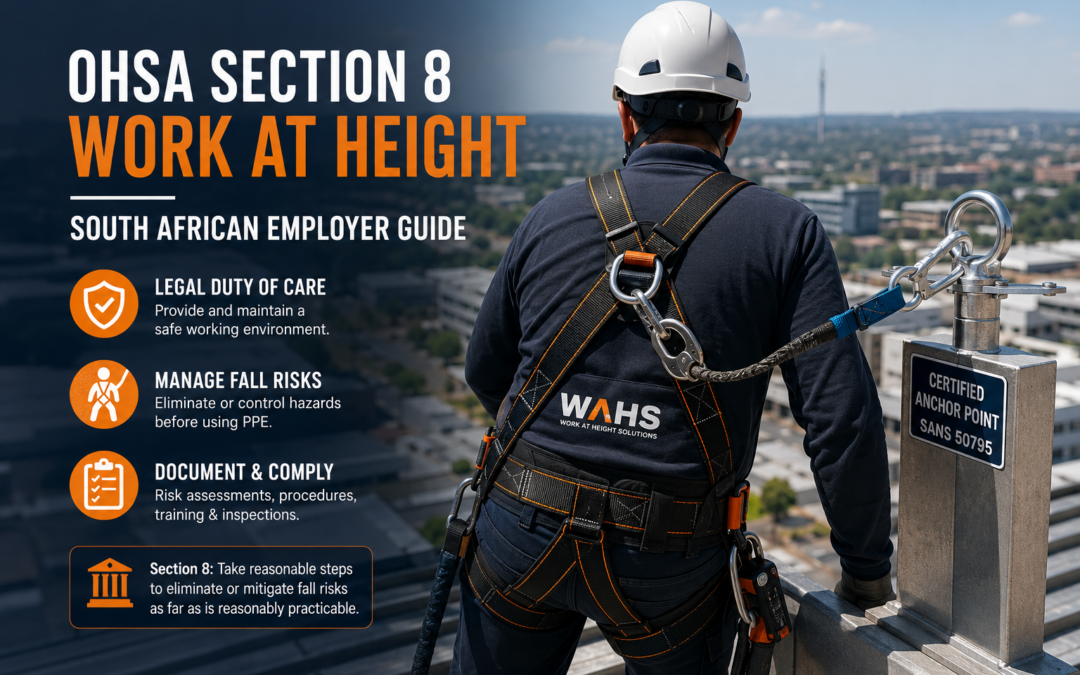
Falls from height remain one of the leading causes of fatal occupational injuries in South Africa. Behind almost every preventable fatality is the same root cause: an employer who did not take the legal duty of care seriously — or did not understand what that duty actually required of them.
That duty is not buried in technical regulations or obscure standards. It sits at the very heart of the Occupational Health and Safety Act 85 of 1993 (OHSA) — specifically in Section 8. If you employ people, or if people work on your premises, Section 8 applies to you. This post explains what it says, what it means in practice for work at height, and what steps you need to take to demonstrate compliance.
What does OHSA Section 8 actually say?
Section 8(1) of the OHSA imposes a general duty on every employer: every employer must provide and maintain, as far as is reasonably practicable, a working environment that is safe and without risk to the health of employees.
Section 8(2) then breaks that general duty into specific obligations. The one most directly relevant to work at height is Section 8(2)(b), which requires an employer to take such steps as may be reasonably practicable to eliminate or mitigate any hazard or potential hazard to the safety or health of employees before resorting to personal protective equipment.
Three words in that sentence carry enormous legal weight: reasonably practicable. This is not a passive standard. It does not mean “we put up a sign” or “we told workers to be careful.” It means you must actively identify fall risks, evaluate them, and implement controls — in a specific order of priority — before you can claim compliance.
The hierarchy of control and what it means for fall risk
South African occupational health and safety law follows a well-established hierarchy of controls. When it comes to fall risk, the law expects employers to work through this hierarchy in order — not to jump straight to issuing a harness and calling it done.
The hierarchy, applied to work at height, runs as follows. First, eliminate the risk entirely — can the work be done from ground level, or can the task be redesigned so that no one needs to go to height? If elimination is not practicable, substitute with a less dangerous method. If substitution is not practicable, implement engineering controls — permanent guardrails, certified anchor points, mono-rail systems, or suspended access equipment. Only once engineering controls have been properly considered and implemented where possible does personal protective equipment (PPE) such as harnesses and lanyards become the primary focus.
The significance of this hierarchy is that an employer cannot simply hand a worker a harness and claim compliance with Section 8. The harness may still be required, but the engineered systems that give that harness something safe to connect to — and that eliminate or reduce the fall risk in the first place — must come first. This is why certified anchor points, lifeline systems, and properly installed suspended access equipment are not optional extras. They are the engineering control layer the law demands.
Who does Section 8 apply to?
Section 8 applies to every employer in South Africa — not only construction companies. If your building has a façade that needs cleaning, a roof that requires maintenance, telecommunications equipment at height, solar panels, signage, or any other feature that requires workers to access height, you have a work-at-height risk on your premises and Section 8 applies to you.
This catches property owners and facilities managers who sometimes assume their duty of care ends with the contractor they appoint. It does not. Under OHSA, a property owner who provides a workplace — even temporarily, for a contractor — carries obligations under Section 9 (duties of persons who manage or control premises) that run alongside the contractor’s obligations. The liability does not transfer entirely when you appoint someone else to do the work.
For construction sites specifically, the Construction Regulations 2014 layer additional requirements on top of the OHSA general duty — including the mandatory Fall Protection Plan under Construction Regulation 10. But even outside formal construction sites, Section 8 of the OHSA remains the baseline obligation for any employer or property owner.
What does “reasonably practicable” require you to do?
Courts and the Department of Employment and Labour interpret “reasonably practicable” by weighing the severity and probability of harm against the cost and difficulty of preventing it. Falls from height score very high on severity — the consequences are frequently fatal or permanently disabling. That means the bar for what is “reasonably practicable” to implement is correspondingly high.
In practical terms, demonstrating that you have met the reasonably practicable standard for work at height typically requires all of the following.
A documented risk assessment that identifies every fall risk on the premises or site, evaluates the likelihood and consequence of a fall, and records the controls implemented. This document must exist before work at height commences — not after an incident.
Engineered controls appropriate to the risk — for most commercial and industrial buildings, this means certified anchor points compliant with SANS 50795, or a horizontal lifeline system, or a mono-rail track system, depending on the nature and frequency of access required. These systems must be installed by a competent person and inspected annually by a registered Lifting Machine Inspector (LMI).
A written procedure or safe work method for every work-at-height task, specifying the equipment to be used, the competencies required, and the rescue plan in the event of a fall or suspension incident.
Evidence that workers are trained and competent to use the equipment and follow the procedure. Training records must be kept.
Inspection and maintenance records for all work-at-height equipment. The OHSA and its regulations require equipment to be maintained in a safe condition — a harness that has never been inspected, an anchor point with no certification record, or a suspended platform with no maintenance log does not meet this standard.
The paper trail matters as much as the hardware
One of the most important — and most frequently misunderstood — aspects of OHSA compliance is that the law requires you to be able to demonstrate compliance, not merely to achieve it. When a Department of Employment and Labour inspector arrives on site, or when a fatality triggers an investigation, the question is not only “did you have safe systems?” — it is “can you prove it?”
This is where many employers fall short. The anchor points may have been installed years ago by a reputable contractor. But if there is no annual LMI inspection certificate on file, no maintenance record, and no risk assessment that references those anchor points, the employer cannot demonstrate compliance. In the event of a fatality, that gap in documentation becomes the central issue in both criminal and civil proceedings.
A proper compliance trail for work at height includes: the original installation certificate for every anchor point or lifeline system; annual LMI inspection reports for all suspended access equipment; a current risk assessment; a current Fall Protection Plan (where required by the Construction Regulations); training records for all workers who perform work at height; and inspection logs for all PPE.
The consequences of non-compliance
The OHSA does not treat non-compliance as a minor administrative matter. Section 38 of the Act creates criminal liability for employers who fail to comply with its provisions. Directors and senior managers can be prosecuted in their personal capacity. Fines and imprisonment are both provided for.
Beyond criminal liability, a fatality or serious injury on your premises opens the employer to civil claims for damages. In cases where the employer cannot demonstrate that they took the reasonably practicable steps required by Section 8, the civil exposure is significant.
The Department of Employment and Labour also has the power to issue prohibition notices — stopping work on a site immediately — where an inspector concludes that a serious risk to safety exists. The commercial cost of a work stoppage on a construction or maintenance project can quickly exceed the cost of proper compliance many times over.
What Section 8 compliance looks like in practice for work at height
For a property owner or facilities manager, OHSA Section 8 compliance for work at height means ensuring that before any work at height takes place on your building — whether by your own maintenance staff or by a contractor — the following are in place. Every point of access to height has a certified, inspected anchor system. An annual LMI inspection has been completed and the certificate is current. A risk assessment specific to your building’s maintenance requirements exists and is reviewed regularly. Any contractor you appoint can demonstrate their own competence and compliance — including their workers’ training records and their equipment inspection certificates.
For a principal contractor on a construction site, it means all of the above, plus a site-specific Fall Protection Plan compiled by a competent person before work at height commences, as required by Construction Regulation 10.
For an HSE manager or OHS officer, it means maintaining the compliance trail described above, conducting regular inspections, and ensuring that the organisation can produce documentation on demand — whether for a DoL inspector or in response to an incident.
How WAHS helps employers meet their Section 8 obligations
Work at Height Solutions is South Africa’s only work-at-height specialist simultaneously holding ECSA-registered Lifting Machine Inspector status, LME registration with the Department of Employment and Labour, and founding membership of the Institute for Work at Height (IWH). This means we operate across the entire compliance chain — from the design and installation of engineered anchor systems and suspended access equipment through to the statutory annual inspections and the certification documentation your compliance file requires.
Our LMI inspection and certification service produces the inspection reports and compliance certificates that form the backbone of a defensible Section 8 compliance record. Our RS Anchor Device installations are engineered to SANS 50795 and chemically bonded to the structure — not proprietary clip-on systems that may not withstand the load a real fall arrest event generates.
If your team needs formal work-at-height training to complete the compliance picture, our group affiliate Altramed provides accredited work-at-height training aligned to SAQA unit standards 229998, 229995, and 229994.
Frequently asked questions
Does OHSA Section 8 apply to me if I am not in the construction industry?
Yes. Section 8 applies to every employer in South Africa regardless of industry. If workers access height on your premises for any reason — maintenance, cleaning, inspection, installation — you have a work-at-height obligation under the OHSA.
Is issuing PPE sufficient to comply with Section 8?
No. Section 8(2)(b) explicitly requires you to eliminate or mitigate hazards before resorting to personal protective equipment. PPE is the last layer of protection, not the first. Engineered controls — anchor points, lifeline systems, guardrails, properly certified suspended access equipment — must be evaluated and implemented first.
How often must work-at-height equipment be inspected to maintain compliance?
Anchor points must be inspected and certified by a registered LMI every 12 months. Suspended access equipment has its own inspection frequency requirements under SANS 51808 and the applicable regulations. All inspection records must be retained and available for DoL inspection on demand.
Can a DoL inspector shut down my site for work-at-height non-compliance?
Yes. An inspector has the power to issue a prohibition notice stopping work immediately where a serious safety risk is identified. Missing anchor point certificates, uninspected suspended access equipment, and the absence of a Fall Protection Plan on a construction site are all grounds for such action.
Where can I find the full text of OHSA Section 8?
The Occupational Health and Safety Act 85 of 1993 is publicly available from the Department of Employment and Labour. The Construction Regulations 2014, which layer additional obligations on top of the OHSA for construction work, are published in Government Gazette No. 37305 of 7 February 2014.
Get a Quote
Speak to a specialist about your work at height requirements. Complete the form below and we will get back to you promptly.
Published by Jaco Coetzer | Work at Height Solutions (Pty) Ltd