
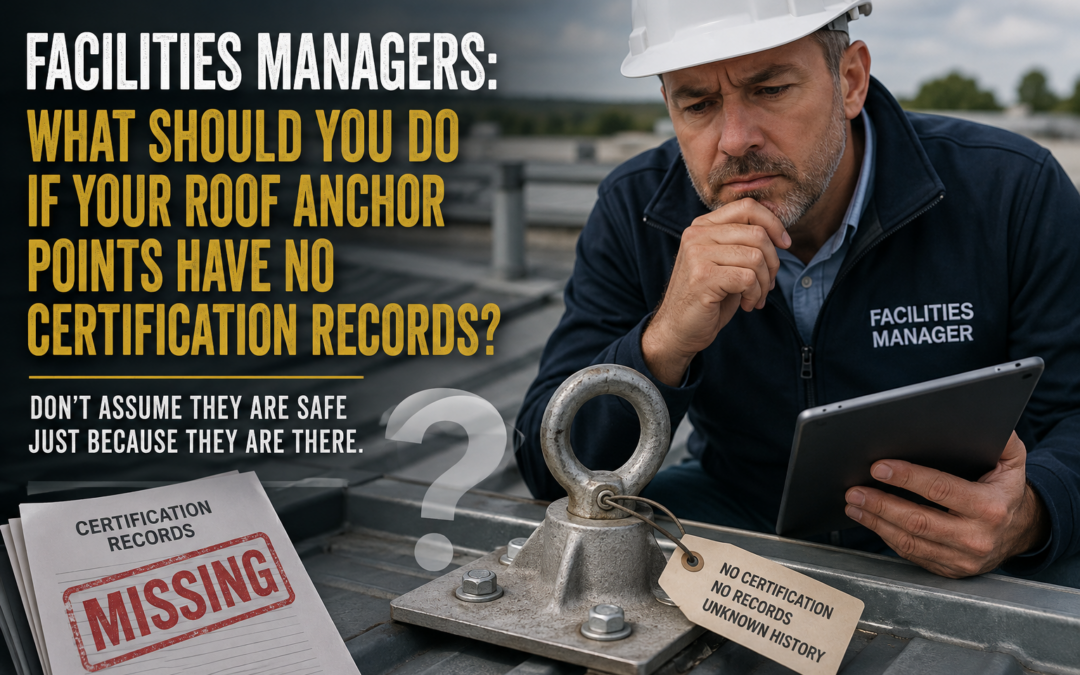
Your contractor arrives to carry out roof work and asks where they can attach their harnesses. You point to the anchor points already installed on the building — and then somebody asks for the certification.
Nobody can find it.
There are no drawings, no installation certificate, no inspection history and nobody is quite sure who installed the anchors or when they were last checked.
For a facilities manager, this creates a difficult question:
Can you allow contractors to use the anchors simply because they are already there?
The safe answer is no. An existing anchor point should not automatically be considered suitable simply because workers have used it before.
An anchor point is part of a fall-protection system
A roof anchor is not simply a piece of metal fixed to a building.
Its suitability depends on several things working together, including:
- The anchor device
- The method used to fix it
- The structure supporting it
- The intended number of users
- The type of fall-protection system
- The loads that could be imposed during use or a fall
- Its position in relation to the work area
This is why a visual inspection alone cannot always establish whether an unknown anchor installation is suitable.
The most important question is not “Does it look strong?”
Facilities managers are sometimes presented with anchors that appear substantial.
The steel may look thick. The bolts may appear secure. Workers may even say:
“We’ve been using these anchors for years.”
None of that establishes what the anchor was designed for.
You need to know whether the anchor and the supporting structure are suitable for the intended fall-protection application.
This is especially important if the system could be used for fall arrest rather than merely work restraint.
What records should you try to find?
If existing anchors are installed on your building, start by looking for any information relating to the original system.
This may include:
- Design information or drawings
- Installation records
- Certificates supplied when the system was installed
- Manufacturer information
- Anchor identification or numbering
- Previous inspection reports
- Maintenance or repair records
- Any restrictions on how the anchors may be used
The objective is to establish exactly what was installed, how it was intended to be used and whether that information can still be verified.
What if there are no records at all?
This is common on older commercial and industrial buildings.
The anchors may have been installed during construction, by a previous building owner or by a contractor many years ago.
If the history cannot be established, do not simply create certainty by assumption.
The system should be assessed before workers are permitted to rely on it for fall protection.
The assessment may need to consider:
- The type and condition of the anchor
- The substrate or supporting structure
- The fixing method
- Corrosion or physical damage
- Previous alterations to the roof or structure
- The intended use of the anchor
- Whether additional structural or engineering information is required
A pull test alone does not necessarily answer the question
This is an important distinction.
An anchor passing a load or pull test does not automatically establish that the entire anchor arrangement was correctly designed for its intended fall-protection application.
The anchor itself is only one part of the load path.
The fixing method, supporting structure, intended system and potential forces all need to be considered.
We explain this issue in more detail in Why Most Anchor Points in South Africa Fail the Design Test.
Do not let a contractor choose an unknown anchor because it is convenient
A contractor may arrive on site and find several eyebolts, brackets or other fittings near the work area.
That does not mean those fittings should be used for fall protection.
Before work begins, the fall protection plan should identify the anchorage arrangement that will be used.
If the contractor says:
“We will just clip onto those existing anchors.”
a facilities manager is justified in asking:
“How do we know those anchors are suitable?”
What if contractors have used the anchors before?
Previous use is not certification.
An anchor may have been used dozens of times without an incident and still have an uncertain design, installation or inspection history.
Facilities managers should be particularly cautious where:
- No identification is visible
- No records can be produced
- The installer is unknown
- The roof has subsequently been modified
- Corrosion or damage is visible
- The intended number of users is unknown
- Nobody knows whether the anchor was intended for restraint or fall arrest
What should the facilities manager do before allowing use?
The practical approach is simple:
- Do not assume the anchor is suitable.
- Look for the original documentation and inspection history.
- Establish how the contractor intends to use the anchor.
- Have the anchor system assessed if its suitability cannot be verified.
- Do not permit workers to rely on the system until you have reasonable confidence that it is suitable.
This does not mean that the facilities manager has to personally certify the system.
It means recognising when specialist assessment is required.
This is exactly the uncertainty facilities managers should remove
One of the hardest parts of managing work at height is dealing with equipment inherited with the building.
You may have anchors everywhere but very little information about them.
That uncertainty becomes a problem the moment a contractor asks permission to use the system.
Your goal should be to move from:
“Those anchors have always been there, so I assume they are fine.”
to:
“We know what the system is, how it may be used, its condition and whether it is suitable for the work being planned.”
Need help assessing existing roof anchor points?
Work at Height Solutions can assess existing fall-protection anchor systems and help facilities managers determine what information is available, what gaps exist and what further inspection, testing, design verification or remedial work may be required.
If contractors are asking to use roof anchors and you cannot produce the supporting records, establish whether the system is suitable before somebody relies on it for their safety.
Frequently asked questions
Can contractors use existing roof anchor points if there is no certification?
Existing anchors should not simply be assumed suitable when their design, installation or inspection history cannot be verified. The system should be assessed before workers rely on it for fall protection.
Does an anchor point passing a pull test prove that it is compliant?
Not necessarily. A test result does not by itself establish that the anchor, fixing method, supporting structure and complete fall-protection arrangement were correctly designed for the intended use.
What records should a facilities manager keep for roof anchors?
Where available, keep the design and installation information, identification records, certificates, manufacturer information, inspection reports, maintenance records and any restrictions relating to the use of the system.
Can an old eyebolt be used as a fall-arrest anchor?
It should not be treated as a fall-arrest anchor simply because it appears strong or can accept a connector. Its suitability for the intended fall-protection system must be established.
What if nobody knows who installed the roof anchors?
If the original installation cannot be verified, have the system assessed rather than assuming it is suitable based on previous use.
Who should assess an existing fall-protection anchor system?
The assessment should be carried out by a person competent to evaluate the particular anchor system, its installation, supporting structure and intended fall-protection application.