
Not All Anchor Points Are Equal — And the Difference Could Cost You Your Compliance Certificate
Walk around any commercial building in South Africa and you will find anchor points installed on rooftops, façades, and plant decks. Some are engineered and certified. Some are not. Many have never been inspected. And a significant number were specified — or installed — without a proper understanding of what type of anchor device the work actually requires, or whether the person who selected and installed them was competent to do so.
This is not a minor administrative issue. Under the Occupational Health and Safety Act 85 of 1993 (OHS Act) and the Construction Regulations 2014, the employer and principal contractor carry the legal duty of care. If a worker falls from height and the anchor point was the wrong type for the task, was installed by someone without the requisite competency, or was never tested correctly — that liability falls squarely on the building owner or contractor who permitted the work to proceed.
This post explains the recognised anchor point types under SANS 50795 and its supporting international standards, how each is used, and — critically — who is actually qualified to select, install, and test them.
The Standards WAHS Uses to Design, Install, and Test Anchor Points
SANS 50795:1996 is the currently accepted South African standard for anchor devices used in personal fall protection systems, and it remains the gazetted, statutory benchmark for compliance in South Africa. It does, however, have known limitations — limitations that were subsequently addressed in the 2012 update to the underlying European anchor standard, EN 795.
The Occupational Health and Safety Act does not prohibit reference to standards beyond SANS. Because of that, WAHS designs, installs, and tests its anchor systems against the full set of relevant standards, applying whichever combination is technically appropriate to the anchor system in question, rather than treating SANS 50795:1996 as the only reference point:
EN 795:2012 updates and extends the anchor device standard on which SANS 50795:1996 was originally based, closing gaps in the older edition. It covers temporary and removable anchor devices — devices designed to be demounted from the structure for periodic examination rather than fixed permanently as part of the building fabric — and classifies these devices into Types A through E according to design and intended use.
EN 17235:2024 is the complementary standard that covers permanent anchor devices and safety hooks — devices intended to be fixed to or into a building or civil engineering structure and remain there permanently as part of the works. This is the more precisely applicable standard for the type of anchor systems WAHS manufactures and installs, such as the RS Anchor Device, which is chemically bonded into the structure and left in place. It groups permanent devices into Kits A through D and sets out dynamic and breaking-load test requirements expressed in classes according to the number of simultaneous users — Class 1 for one person, up to Class 4 for four persons.
CEN/TS 16415:2013 is the supplementary technical specification that applies where more than one person may need to be attached to the same anchor device or anchor line at the same time — a rope access team working in close proximity, or a rescue in progress alongside a person already on the system. Multi-user loading is not automatically covered by a single-user rating.
WAHS applies all four of these standards together in the design, installation, and testing of anchor points in South Africa — SANS 50795:1996 as the statutory South African reference, and EN 795:2012, EN 17235:2024, and CEN/TS 16415:2013 as the more current and more detailed technical frameworks that inform the actual engineering, depending on whether the device is temporary or permanent and how many users it must serve.
Permanent vs Temporary — Why the Distinction Matters
Under EN 17235:2024, a permanent anchor device is one installed to become part of the load-bearing structure or roof construction and intended to remain there — the RS Anchor Device, once chemically bonded into concrete, falls squarely into this category. A temporary anchor device under EN 795:2012 is designed to be demounted and moved between locations or removed for bench inspection.
This is not a semantic distinction. Because a permanent anchor device cannot be removed for bench testing once installed, EN 17235:2024 places the testing burden on the manufacturer’s type approval — dynamic testing, breaking load testing, and corrosion durability assessment carried out on representative mock-ups of the actual substrate the device will be fixed into (concrete, structural steel, timber, or trapezoidal roof sheeting) before the product is ever installed on a client’s building. This is why manufacturer test documentation and a Declaration of Performance matter as much as the on-site installation record — the client is relying on type-tested performance for a device they will never see bench-tested again.
The Anchor Point Types
Type A — Fixed Single-Point Anchor Devices
Type A is the most widely recognised category: a single stationary anchor point fixed to the structure by means of structural anchors or fixing elements. The classic example is a chemically bonded anchor device installed into a concrete substrate, designed for individual attachment — one worker, one anchor point.
Within the Type A category, SANS 50795 recognises Class A1 anchors as “basic anchors” — chemical anchors installed into concrete of at least C20/25 quality. This is an important distinction because it defines the boundary of competency for anchor point selectors and installers.
When to use it: Rooftop anchor points for rope access contractors, façade maintenance attachment points for individual operatives, and inspection access anchor points on plant decks or roof plant areas.
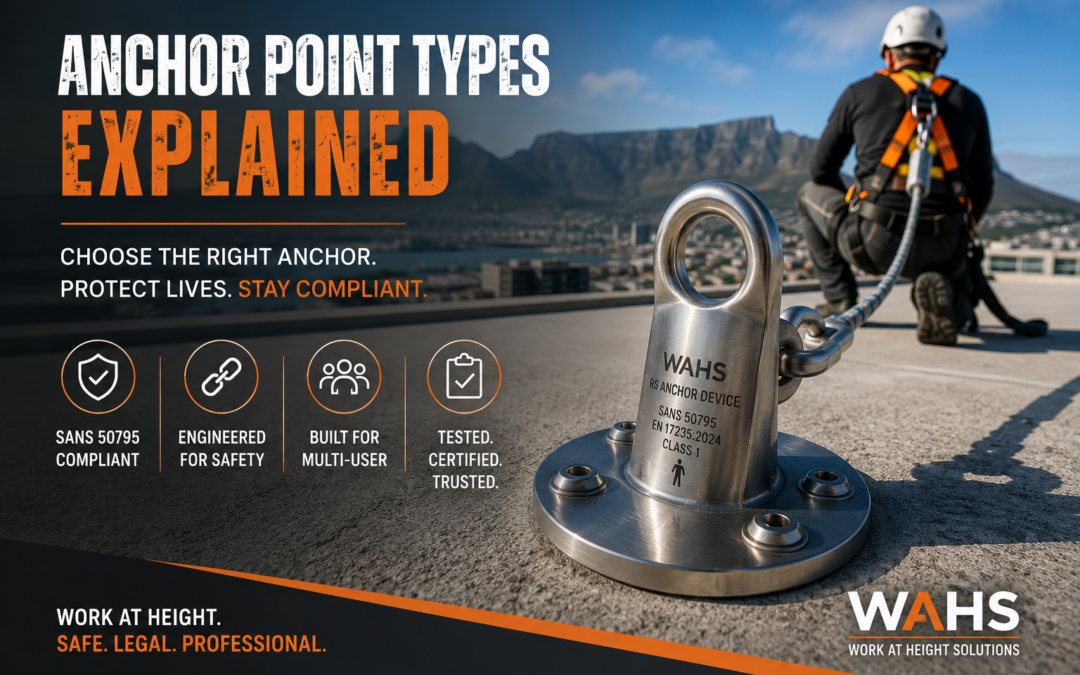
WAHS application: The RS Anchor Device — WAHS’s engineered 6 mm stainless steel anchor device, chemically bonded to concrete via stainless steel structural anchors — is a permanently installed Type A / Kit A device, manufactured and tested to SANS 50795 and EN 17235:2024. Annual inspection and re-certification of installed RS Anchor Devices is performed by WAHS’s ECSA-registered Lifting Machine Inspectors as part of our full-service maintenance programme.
Type B — Portable, Self-Weight or Friction-Based Anchor Devices
Type B anchor devices do not require structural anchors or fixing elements. They rely on self-weight, mechanical clamping, or configuration — such as a tripod system over a roof penetration, a beam clamp, or a sling-over-structure device — to resist load. These devices are characteristically portable and re-deployable, and remain governed by EN 795:2012 rather than EN 17235:2024, as they are never permanently fixed to the structure.
When to use it: Temporary access in locations where chemical bonding or drilling into the substrate is not possible or permitted — listed structures, certain heritage buildings, or sites where substrate quality cannot be confirmed. Also used for confined space access where a tripod provides overhead attachment above a hatch or manhole.
Important limitation: Type B devices are not a substitute for permanently installed and substrate-bonded Type A devices where regular repetitive access is required. Their load-bearing performance depends on correct setup by a competent person on every deployment — a human error variable that does not exist with a permanently installed and annually certified system.
New Under EN 17235:2024 — Kit B: Permanent Safety Hooks
EN 17235:2024 introduces a category not previously formalised under SANS 50795: the permanent safety hook. This is a fixed, hook-shaped anchor point built into the roof edge or eaves detail, intended specifically for attaching temporary roof ladders and temporary work platforms — not for permanent ladders or platforms. The standard prescribes specific geometry: an opening of no less than 80 mm and no more than 150 mm, with a hook height of at least 120 mm.
When to use it: Pitched roof edges and eaves details where a roof ladder needs a permanent, purpose-built attachment point rather than a general-purpose anchor. This is a distinct product from a Type A anchor point and should not be substituted for one.
Type C — Flexible Horizontal Lifeline Systems
Type C anchor devices employ a flexible anchor line — typically wire rope — running horizontally between two or more extremity anchors, with intermediate support anchors along the span. A mobile anchor point (traveller) runs along the line and connects to the worker’s harness, allowing continuous attachment while traversing a route, including past intermediate anchors.
The forces involved are far greater than most people expect: at a shallow sag angle, a single fall arrest load generates a theoretical line tension many multiples higher than the arrest force itself — and the applicable safety factor requirements mean the rope’s minimum breaking strength must be substantially higher than the maximum calculated line tension, anchored with appropriately sized fixings into a structure verified to carry those loads.
The design of a lifeline system falls within the scope of competence of a professional engineer. This is stated explicitly in the anchor selection technical literature that underpins SANS 50795 compliance. A rope access supervisor, fall protection planner, LMI, or SACPCMP-registered OHS officer is not competent to design a lifeline system by virtue of those qualifications alone.
When to use it: Any situation where multiple workers need to traverse a linear route while remaining continuously attached — rooftop maintenance paths, ridge lines, and edge traversal routes. Particularly effective on low-slope roofs where a single fixed anchor point cannot cover the full working area.
WAHS application: Where WAHS installs a wire lifeline system as a permanent fixture, it is tested and classified as an EN 17235:2024 Kit C system; temporary or removable wire lifeline installations remain governed by EN 795:2012 Type C.
Type D — Rigid Horizontal Rail Systems (Mono-Rail)
Type D anchor devices use a rigid anchor line — typically a steel or aluminium rail or tube — deviating from the horizontal by no more than 15 degrees. Like Type C, a mobile anchor point (traveller) runs along the rail. Unlike flexible cable systems, the rigid rail provides a defined, predictable travel path with minimal deflection under load and the ability to navigate building geometry through engineered corners and bends.
When to use it: Façade traversal routes on multi-storey buildings, roof edge rails, and any application where the predictability of a rigid track is preferred over the deflection behaviour of a cable system, or where cornering around building geometry is required. Type D is also the correct specification where aesthetics matter — rigid rail systems can be designed to be visually unobtrusive on high-profile commercial façades.
WAHS application: WAHS supplies and installs mono-rail systems to SANS 50795 Type D requirements, tested and classified as EN 17235:2024 Kit D permanent installations, designed around the specific geometry and substrate of each building.
Type E — Dead-Weight Anchor Devices
Type E anchor devices rely solely on mass and friction between the device and the surface to resist load. They are designed for use on surfaces up to 5 degrees from the horizontal. After a fall arrest event, the standard requires that the leading edge displacement does not exceed 1,000 mm and that the device remains stationary. There is no permanent equivalent of this category under EN 17235:2024 — by definition, a dead-weight device is not fixed to the structure.
When to use it: Flat or near-flat roof surfaces where drilling or bonding is not permitted, and where the roof surface and device combination has been verified by the manufacturer and system designer. Type E is the least commonly used category in South Africa’s commercial sector and should only be specified following a competent system design assessment.
Why WAHS Does Not Use Eyebolts or Eyenuts — and Advises Clients Against Them
Walk through any older commercial building in South Africa and you will find eyebolts or eyenuts installed as fall arrest anchor points. They are cheap, widely available, and look the part. They are also fundamentally problematic for fall protection use — and WAHS’s position is unambiguous: we do not specify eyebolts or eyenuts for fall arrest, and we advise clients to replace them.
Here is why.
The orientation problem. A fall arrest anchor point must be oriented so that the load from the lanyard or rope is applied in the correct direction — along the plane of the ring, not across it. Once a chemical anchor bolt has been set and cured in concrete, it cannot be rotated. When the eyenut is then threaded onto the bolt and tightened, the probability of the ring ending up in exactly the correct orientation for the applied load is close to zero. If you back the nut off to correct the orientation, the eyenut is now loose — the bolt is unsupported and will bend under a fall arrest load, and the nut can work itself completely free. A loose anchor point is not an anchor point.
The cross-loading problem. Eyenuts can only sustain their full rated safe working load when the load is applied in pure axial alignment with the plane of the ring. Any load applied laterally — across the ring rather than along its curvature — is what the standards call cross-loading or lateral loading, and it is expressly prohibited by manufacturers. Even a load applied at 90 degrees to the axis of the anchor bolt, but still within the plane of the ring, reduces the allowable load to half the marked safe working load. In practice, given that orientation cannot be controlled at installation, cross-loading is not an exception — it is the norm.
The size problem. The vast majority of eyenut installations in South African buildings use M12 anchor bolts. A top-of-range M12 eyenut has an axial safe working load of around 340 kg. Fall arrest anchor devices are required to have a minimum working load capacity of 600 kg. An M12 eyenut therefore cannot be legitimately specified for fall arrest use — it is undersized before any orientation or cross-loading penalty is applied.
The substrate problem. Anchor points must bear directly against hard, load-bearing concrete. Plaster render and non-load-bearing waterproofing membranes — which cover the concrete surface of most post-construction installations — are not load-bearing. An eyenut tightened against render rather than bare concrete leaves the anchor bolt unsupported across the thickness of the render layer, creating a lever arm that generates bending stress in the bolt under a fall arrest load. The correct installation requires all soft materials to be removed from the bearing surface before the anchor point is seated.
The WAHS RS Anchor Device is specifically engineered to address these problems. Its plate-type design bears directly against the concrete substrate, its load direction geometry is not dependent on rotational orientation at tightening, and it is manufactured and tested to SANS 50795 and EN 17235:2024. If you have eyenuts installed on your building and they are being used for fall arrest or rope access, contact WAHS for an audit.
Single-User vs Multi-User Anchor Devices
SANS 50795 and EN 795:2012 both address single-user anchor devices as the base case — a device to which one person is attached at any one time. Multi-user anchor devices — designed for simultaneous attachment by more than one person — are addressed separately under CEN/TS 16415:2013, and under EN 17235:2024’s class system for permanent kits (Class 2 for two persons, up to Class 4 for four persons), imposing substantially higher load requirements.
This distinction has real consequences on site. If a rope access team of three operatives needs to attach simultaneously to the same anchor point, a single-user device is not the correct specification. This is one of the most common specification errors encountered on South African commercial buildings — and it means that a certified single-user anchor point may be used daily in a way that renders the certificate meaningless.
Who Is Qualified to Select, Install, and Test Anchor Points?
This is the most misunderstood area in the South African work-at-height sector — and getting it wrong creates serious legal exposure.
The following qualifications or registrations do not, on their own, confer competency to select, install, and test anchor points for fall protection: rope access Level 3 technician (rope access supervisor) status; registration with the SACPCMP as a Construction Health and Safety Officer; ECSA registration as a Lifting Machine Inspector (LMI); or manufacturer training for the installation of chemical anchors or expansion anchors in general.
All of these are legitimate qualifications in their own right — but none of them addresses the specific engineering knowledge required to select and install anchor points correctly for fall protection use.
The competency required for anchor point selection and installation is covered by the IWH’s own learning programme: LNQ 20190036 — KM 01: Select Anchor Points for Fall Protection (NQF Level 4, 4 credits). This programme covers reaction loads, direction of applied forces, combined shear and tensile forces, bending moments and bending stress, substrate assessment, and anchor selection — the engineering fundamentals that underpin a correctly specified and installed anchor point.
Pre-entry requirements for the programme are demanding by design: a supervisory-level qualification at NQF Level 4 or above, certification to at least US 229998 (Work in a Fall Risk Position) or equivalent, NQF Level 4 Mathematics and Literacy, and certification from an IWH-approved anchor manufacturer for the practical module.
The scope of this IWH learning programme is explicitly limited to Class A1 basic anchors — chemical anchors into concrete of at least C20/25 quality. Any anchor installation that exceeds the Class A1 criteria — including all Type C and D lifeline and rail systems — must be designed and approved by a professional engineer registered with ECSA. This is not optional and is not addressed by the IWH anchor installer programme.
WAHS is unusual in the South African market in holding both credentials required across the full compliance chain: ECSA-registered LMI status for statutory inspection and certification of installed systems, and — through its engineering and design process — access to IWH-recognised anchor selection competency and professional engineering sign-off for the anchor systems themselves. Most providers in this market hold one half of that chain, not both.
What Compliance Actually Requires
The question WAHS most frequently encounters from building owners and HSE managers is: “We have anchor points. Are they compliant?”
The answer is rarely a simple yes or no. A compliant anchor system requires all of the following:
- Correct product selection — The anchor device must be of the correct type for the task, manufactured and tested to SANS 50795 and, where permanently installed, EN 17235:2024, with a manufacturer’s technical file and marking.
- Competent selection and installation — For Class A1 basic anchors, selection and installation must be performed by a person who has completed the IWH-recognised learning programme (LNQ 20190036 or equivalent). For any anchor system beyond basic Type A — including all lifeline and rail systems — design must be undertaken or approved by a professional engineer.
- Correct load testing — Load testing must be performed at the prescribed minimum load and in the direction of the applied force in service. Pull-out testing alone — axial loading only — does not validate an installation where bending moments and shear forces will be present in actual use. This is a critical and widely misunderstood distinction.
- Substrate verification — The structural anchor must be installed into substrate of confirmed quality, at the correct edge distances, spacing, and embedment depth. The thickness of any plaster render or waterproofing membrane must be established, as this affects the free (cantilever) length of the anchor bolt and the bending moment it must resist. Render is not a load-bearing material and must be removed from the contact surface between the anchor device and the concrete.
- Annual inspection and recertification — Installed anchor systems must be inspected at regular intervals — typically twelve months — by a competent person. An inspection report and compliance certificate must be issued after each inspection.
- A system technical file retained by the building owner — Including design documentation, installation records, load test results, inspection reports, and manufacturer information for all components. This file must be maintained for the life of the installation.
The Cost of Getting It Wrong
A pull-out test certificate issued by a person without anchor point selection and installation competency is not a SANS 50795 compliance certificate. An anchor point installed by a rope access technician without IWH anchor installer competency is not a compliant installation — regardless of how it looks and regardless of whether it passed a pull-out test on the day.
The Department of Employment and Labour does not require a fatal incident before enforcing OHS Act compliance. A Section 26 audit, a contractor safety file review, or a routine inspection can expose non-compliant anchor systems. The consequences range from prohibition notices stopping work on site to prosecution of the employer under Section 38 of the OHS Act and civil liability in the event of an incident.
The cost of a correctly specified, competently installed, and annually inspected anchor system is a fraction of the cost of a single enforcement action or incident investigation — and it is the only way to genuinely discharge the Section 8 duty of care to your workers.
Frequently Asked Questions
What is the difference between EN 795:2012 and EN 17235:2024?
EN 795:2012 governs temporary and removable anchor devices, designed to be taken off the structure for periodic examination. EN 17235:2024 governs permanent anchor devices and safety hooks that are fixed into the building fabric and remain there for the life of the installation. Both sit alongside SANS 50795:1996 as the gazetted South African legal reference.
Is SANS 50795:1996 still the legal standard in South Africa?
Yes. SANS 50795:1996 remains the currently gazetted South African standard for anchor devices used in personal fall protection systems and is the statutory benchmark for compliance in South Africa.
Can an ECSA-registered LMI select and install anchor points?
No. ECSA registration as a Lifting Machine Inspector does not, on its own, confer competency to select, install, or test anchor points for fall protection. That competency sits with the IWH’s LNQ 20190036 learning programme for Class A1 basic anchors, and with a professional engineer for anything beyond that.
Why does WAHS not use eyebolts or eyenuts as anchor points?
Standard eyebolts and eyenuts cannot be reliably oriented for correct load direction once installed, are prohibited from cross-loading by their own manufacturers, are typically undersized (M12 eyenuts are rated to roughly 340 kg against a 600 kg minimum requirement), and are frequently seated against non-load-bearing render. WAHS specifies the RS Anchor Device instead, which is engineered to eliminate all four problems.
Talk to WAHS About Your Anchor Points
If you are a facilities manager or building owner, an annual LMI inspection and certificate from WAHS is the clearest way to know whether the anchor points on your building will hold up to scrutiny in a DoL audit. If you are an HSE manager compiling a safety file, WAHS can supply the engineering-certified documentation trail your file needs. And where your team needs training alongside the hardware, WAHS’s group training partner Altramed delivers accredited work-at-height training against SAQA unit standards US 229998, US 229994, and US 229995.
If you are uncertain about the compliance status of anchor points on your building or project, contact WAHS for a site assessment and anchor system audit.
Get a Quote
Speak to a specialist about your work at height requirements. Complete the form below and we will get back to you promptly.
Published by Jaco Coetzer | Work at Height Solutions (Pty) Ltd